Friday, November 28, 2008

The rosary rebellion

The Reformation of the church in England was a long, complex and sometimes bloody process. For those interested in studying this process, I think that one of the great contributions to the literature of religious history in England is Eamon Duffy's account of the Reformation, The Stripping of the Altars: Traditional Religion in England, 1400-1580.

Stripping

This was the first book I encountered on the history of the English Reformation that begins by examining the state of religion in England before the break with Rome, and it was also the first history of the subject I read that was not written from a specifically Protestant point of view. I grew up in a Congregational church, and English-speaking Protestants, understandably, tend to dwell on the aspects of the Reformation that represent their own beginnings. But Duffy's book takes a more comprehensive view. It's joined the short list of books that I strongly recommend to anyone interested in the history of popular devotion, including the rosary.

One of the most interesting rosary-related stories in the book is this one, which I will quote in Duffy's words.

Sometime in Whit week 1549 Walter Ralegh (the father of the famous seaman) was riding to Exeter. Near the village of Clyst St. Mary he overtook an old woman on her way to Mass; she was praying upon a pair of rosary beads in her hand. Ralegh, a staunch supporter of the Reformation, challenged the old woman, asking her what she meant by carrying such beads, "sayenge further that there was a punyshmente by the law apoynted agaynste her and all suche as woulde not obeye & folowe the same & wch woulde bee putt in execution vpon theime." The old woman hurried to the church, where the parishioners, already disgruntled by the imposition of the 1549 prayer-book on the previous Sunday, were gathering for Mass,

"and beinge impacyente & in an agonye with the speches before paste betwen her & the gentleman begyynethe to upbraye in the open Churche verie harde & unsemelie speches concernynge religion, saienge that shee was thretned by the gentleman, that exvcept shee woulde leave her beades & gene over holie breade & water the gentlemen woulde burne theym oute of theire howses & spoyle theim."

The enraged parishioners all but lynched Ralegh, a local mill was burned, and the rebellion escalated. The incident, not without elements of farce, was to end in black tragedy. When ultimately Lord Russell was dispatched by Somerset to put down the rebellion, Clyst St. Mary was the scene of a particularly bloody pitched battle, in which the local peasantry were ruthlessly butchered, along with all the prisoners captured by the royal forces then and previously. The village was put to the torch. Archbishop Cranmer's dislike of beads and holy water had cost the people of Clyst dear.


This mini-rebellion -- to put it in context -- was a local but very significant incident in a larger movement, generally referred to as the Prayer Book Rebellion. The immediate trigger, and the chief grievance of the protesters, was the imposition of a new Prayer Book, which was markedly more Protestant in its declarations of doctrine than many people were prepared to countenance.

Generally speaking, London was the center of Protestant thinking at this period, and in more outlying areas such as the west of England, there were plenty of people who saw no reason to change the ways of thinking and methods of worship that had served them well for hundreds of years.

King Henry VIII had begun the process of reformation in 1534 by denying the authority of the Pope and declaring himself the Supreme Head of the Church in England -- while retaining for himself many Catholic beliefs and practices. The bishops and commissioners he appointed, however, tended to be much more avowedly Protestant. The resulting mix of religion and politics meant that the attempt to bring about a countrywide reformation progressed by fits and starts through the rest of Henry's reign, and enforcement of change at the local level was often sporadic and uneven.

The death of Henry and accession of Edward VI changed all this. A decree specifically banning rosary beads and a number of other Catholic practices was published in 1547. (Below is a nice piece of propaganda, showing some of the now banned items, "Certaine of the Popes marchandize lately sent ouer into Englande")

Contraband3

As this incident shows, however, we have plenty of evidence that people were still using their rosaries. As Duffy points out, the mention of "holie breade & water" indicates that it was not just beads that were the focus of the disagreement, but other specially blessed things as well. Nonetheless, the beads were an easily visible symbol, and the fact that they could be part of a dispute that sparked an armed conflict is some indication of how strongly people could feel about their beads.

Labels:

Monday, November 24, 2008

Beads from the Inventory of Philip II

A recent discussion on the Paternosters mailing list has made me think about all of the fascinating -- and often knotty! -- little questions that arise when we try to make sense out of the very brief descriptions of paternoster beads that survive in inventories, wills and similar lists. Often the description is all we have in the way of data about what the beads were like.

As I've commented elsewhere, these descriptions were not really written for us, hundreds of years later. They were written, for the most part, to assist in keeping track of someone's possessions during life, or sorting out how much they were worth and who they should be passed on to after the owner's death. Since whoever was doing the sorting usually had the actual beads in front of them, only the minimum description was needed, just enough to identify which of several possible sets of beads was being referred to.

On top of that, we are also dealing with historical spelling and vocabulary, which -- to say the least -- are often not identical to the modern versions of either. And as you might expect, some of the words used in the descriptions were never common words in the first place, or else they're being used in a specialized sense -- rather like the word "gauds" in English, which was originally borrowed from the Latin word for joy (Gaudete = Rejoice!) and can mean jewels or ornaments in a general sense, but which when applied to Christian prayer beads specifically refers to distinctive "markers" separating groups of other beads.

The recent discussion on the Paternosters list provided an excellent example, and several of us amateur scholars attacked it with zest.

The question came from Katherine Barich, to whom I am profoundly indebted because she just loves collecting and reading through old inventories in search of interesting bits about historical clothing. This takes a peculiar intellectual gift that I don't think I have. Fortunately she has been very generous about sharing what she finds, and periodically I get an e-mail from her with more paternoster listings for my slowly growing database.

Here's the entry she found in the inventory of Phillip II of Spain, taken in 1594. It is in "Archivo Documental Espanol - Tomo X - Inventarios Reales Bienes Muebles Que Pertenecieron a Felipe II" by F. J. Sanchez Canton.

Un rosario, que tiene sesenta y tres perlas avemariadas y otras cuatro en la cruz, con siete estremos de oro, labrado de medio relieve, con nuebe ruvies en cada un y otro estremo de oro en la cruz con diez ruvies. Tasado en trecientos y noventa y seis ducados.

Philip II, son of Emperor Charles V, was a Hapsburg and brought most of Spain (and for part of the time, Portugal as well) under his rule for a substantial swath of the 16th century. Here's a portrait of Philip II with a rosary, although clearly these are not the beads described in the inventory (for one thing, they're the wrong color):


I'm going to walk through the process I went through to try to make sense of this entry, because I think it's a good example of the sorts of things we frequently encounter.

Here's what Babelfish says (these "translations" always make me giggle):

A rosary, that has sixty and three Rep them avemariadas and other four in the cross, with seven estremos of gold, worked of average relief, with nine rubies in each and a other estremo of gold in the cross with ten rubies. Appraised in three hundred and ninety and six duchies.

OK, fixing the obvious idiocies, we have:

A rosary that has 63 Ave Maria beads [pearls]?, and four more in the cross, with seven [gauds]? of gold, worked in middle relief [bas- relief]?, with nine rubies in each; and another [gaud]? of gold: the cross with ten rubies. Appraised at 396 ducats.

I'm grateful, by the way, to the colleague who clued me in to Babelfish as a deeply flawed, but nonetheless very useful, tool in deciphering a language. What it does do well is to translate a lot of the common words for you, all in one fell swoop, so you don't have to spend your time looking up words like nuebe and sesenta and tasado. Then you attack the less common words one by one, or those that Babelfish clearly doesn't have a clue about.

This is especially helpful for anyone who isn't a full-time scholar. I, for instance, can read French reasonably well considering that the last time I formally studied it was decades ago, and I understand enough about most of the Romance and Germanic languages that I can at least tell which parts of the sentence are what and which way the grammar is going. But for the rest, it's a matter of lots of looking in dictionaries and a good deal of guesswork.

A bit of digging in my ancient Spanish dictionary (Appleton's, 1943, which I got for free from a book exchange) reveals that perlas are indeed pearls, and not (as in German) beads: the normal Spanish words for beads seem to include abalorio and (somewhat more obscurely) chaquillo. (The dictionary lists several more, including cuenta which seems to literally mean "counter.")

Estremo isn't in the dictionary. Hm. I wonder if it's supposed to be estreno, which has to do with "commencement, beginning, inauguration." (16th-century Spanish spelling? Who knows?) At any rate, there are seven of these estremos (plus one), which makes sense if there is one before each decade and extra ones before and after the last three beads.

The online dictionaries I find in a quick search don't contain either estremo or estreno. Going the other way, they prefer to translate "gaud" as adorno (decoration) or joya (jewel). Appleton's translates "gaud" as objecto charro (showy or flashy object).

If the estremos are indeed gauds, we are still not quite home free with the translation. We still have to decipher "y otro estremo de oro en la cruz con diez ruvies." Literally this says "and another estremo of gold en the cross with ten rubies."

First question, what does en mean in this context? Prepositions are notoriously tricky to translate, especially since their use is often strongly idiomatic. Literally the estremo seems to be "in" the cross, which doesn't make very much sense, so I would guess it means "next to."

Second question: which object has ten rubies? The lack of punctuation, or of any relative pronoun, means it's not clear whether we have an estremo with ten rubies, and a cross, or an estremo, and a cross with ten rubies. The fact that all the other estremos have nine rubies each makes me think it's a little more likely that the rubies belong to the estremo. We've also been told already that the cross has four pearls, so perhaps it doesn't need rubies as well. Alas, the jewels were probably re-set and the gold melted down long ago, so we'll never know.

A final interesting point about this rosary: it has 63 pearls. This strongly suggests a Brigittine rosary, which has six decades (rather than the usual five) and three extra beads at the end. I've heard this was a popular type of rosary in the 16th century, but haven't run across many examples. The only surviving example I can recall is this one, which is Portuguese and 17th century:

Aloe-wood

There are several ways the beads of such a rosary could be arranged: this one has all 63 beads in one loop, with six groups of ten and a final group of three. There are only six gauds here, as there are none next to the cross. Other examples of rosaries often do seem, at this period, to have gauds beginning and ending all of the decades including the first and last, so I would not be surprised at all to see a Brigittine rosary with eight gauds.

Labels:

Wednesday, February 07, 2007

It isn't easy, bea(d)ing green...

I'm sure I've already bored everyone with my rhapsodizing about Twelfth Night, but I'm not quite done yet. What can I say: it was a big event, with everyone dressed in their best medieval clothing, the perfect opportunity to show off rosaries.

I had new clothes for the occasion, and took the opportunity to make up a rosary for which I'd had most of the parts for awhile. Except for the materials, it's a reasonably close copy of an original from about 1600 which is now in the Schatzkammer (Treasure House) of the Residenz Museum in München (Munich). I haven't seen this one in person yet; the one time I was in München was thirty years ago, before I was interested in such things. I do plan to go back.

Emerald rosary, ca. 1600

I saw the photo of this in Eithne Wilkins' 1969 book The Rose-Garden Game, of which I published a review here a couple of years ago. It's not quite as bad a book about rosaries as I used to think: the author does have some interesting and soundly factual information in there. The trouble is, you can only tell which is the good stuff and which is not if you've already read several other books.

Emerald rosary, detail

The original piece is one of those incredible objects of art that makes you stand there with your mouth hanging open once you realize what it really is. The gauds (marker beads) are enameled gold, and the description says they are set with tiny diamonds, though those aren't visible in the picture. The spacers between beads, and the bead caps on the cross, are also gold. With the exception of one piece, the entire rest of the rosary is composed of emeralds. Yes: I said emeralds -- real, solid emeralds, at least 6 millimeters in diameter. The only exception is the oval-shaped pendant, which is a "doublet," a sort of sandwich of emerald and glass that jewelers put together to make the gem look bigger than it actually is.

Emerald rosary, cross

Wilkins says the original is German, from around 1600, but I wonder. By far the biggest source of emeralds around that time was in the New World, and Spain owned most of that. It's certainly possible this rosary could have been designed and assembled in Germany, but it could be Spanish, which would account for the relatively large amount of gold used. There were plenty of wealthy people outside Spain, of course, but it would be interesting for a gemologist to examine the emeralds to see where they're from.

The sheer monetary value of this thing is astounding. We hear about wealthy English nobles wearing "the price of an estate" on their elaborately embellished sleeves; this rosary must have been worth the price of a good-sized castle and its entire estate, at least. It's probably worth that much today, too.

However. My excuse for making a copy was the sheer glitz of it all. It's still a spectacular piece of jewelry even though mine is all glass, and the "gold" is gold-colored base metal. The pendant, I bought from a company that sells chandelier parts. (They have good prices and fast shipment, by the way.)

Emerald rosary replica

I wanted something a little special for the Ave beads, and wound up buying hand-made beads from Barefoot Beads, who are also nice folks and gave me good service. I explained my project and asked if they could send me beads that might be slightly irregular and not all the same color, and that's what they did. (The original emerald beads aren't all the same color either.) The one thing they couldn't do was to drill a second hole through one bead so I could use it for the center of the cross, but the jeweler I take all my "weird" projects to was happy to do it.

Emerald replica, detail

Making the cross was a bit challenging. I did have that center bead, with two holes drilled through it at right angles to each other. I wanted to construct the cross the way I think the original was constructed, with the silk thread that holds the beads coming down through the top bead, out to the sides to take in the "horizontal arm" beads, through the bottom bead to hold the pendant, and then back up through the cross.

Emerald replica, cross

This involves making the thread turn a right angle, twice, in the space inside a bead where there's very little room to maneuver (and there is no way you can get your fingers in there). I was quite pleased with my own cleverness when I figured out how to make it work.

I thought of trying to find a tiny hook to catch the thread, but in the end I wound up using two twisted-wire beading needles. I buy steel ones, which are sold for bead weaving, because they're a little stiffer and easier to handle than brass ones.

What I did was to insert the eye of an empty needle through the hole I wanted the thread to come out of. I then threaded the other needle, and pushed it into the hole that was at right angles to the empty needle. I gave a tug on the empty needle, and if it wouldn't move, I knew I had succeeded in putting the second needle through the first needle's eye.

Then all I had to do was to run the second needle completely through the bead, and I could pull up on the first needle to make the thread turn a right angle and come out the side hole. I did the same thing when I needed to divert the thread for the second horizontal arm, and this was even better, because using an eyed needle meant I could just push the thread already in the bead out of the way, ensuring it didn't get caught in the second thread.

This probably makes more sense if you see it rather than hearing me talk about it. Here are diagrams showing the steps in the process:

Step 1:

Cross-bead-1

Step 2:

Cross-bead-2

Step 3:

Cross-bead-3

The finished center bead (threads colored for clarity):

Cross-bead-4

Labels:

Friday, December 29, 2006

Still more 16th-century crosses

part iii


As I mentioned in a couple of previous posts, I keep my eyes open for photos of interesting 16th- and 17th-century crosses, especially those suitable for paternosters or rosaries. Collecting photos trains my "eye" for what is and isn't appropriate for the period -- and most of what's currently produced is not, since fashions have changed.

In this post, I have photos of two crosses that no one would dream of producing nowadays -- and probably the prices on any like them for sale would be in the tens of thousands of dollars. But we can all look at them and drool, anyway....

I've mentioned before that there are a number of 16th-century pieces -- including chalices, reliquaries and at least one rosary -- that contain elaborate miniature religious scenes carved from boxwood. The truly distinctive feature of this group of carvings, though, is that the scenes have a background of carefully inlaid, iridescent feathers. These are thought to be pieces made in the Spanish domains in the New World, and the featherwork seems to have developed out of Native American artistic tradition.

Here is an entire cross composed of these carvings, overlaid with transparent rock crystal. It is quite stunning, and in excellent condition.

Boxwood-cross

The scenes mostly seem to be from the childhood of Jesus: starting with the Annunciation at the left end of the crossbar, Mary's visit to Elizabeth in the center (though I'm not entirely sure of this one, it fits here logically), and the Nativity on the right side of the crossbar.

Below the crossbar, the next scene seems to be the Presentation of the infant Jesus in the Temple -- though this one is rather cryptic. The clues I'm looking at are the pointed hat on the man at left, and the small pillar or whatever it is below the infant.

Below that is the Flight into Egypt (to escape from King Herod's massacre of all young infants -- which we actually celebrated yesterday, December 28th, as the Feast of Holy Innocents).

I'm not certain what the bottom scene is. Logic would suggest the finding of the 12-year-old Jesus in the Temple, where he was preaching to the elders. At any rate, it resembles some other depictions of this scene, which show the young Jesus standing in a sort of pulpit or under a canopy.

At the very top of the cross, the scene is very clearly the Resurrection -- Jesus climbing out of a horizontal tomb chest.

In the closeup view, you can see details of a few of the scenes, and a slightly better look at the feather background, especially in the scene below at right.

Boxwood-detail

The second "ohmigosh, no one could afford this" cross is another one primarily of rock crystal, and this time, compartments in the crystal hold various relics.

I can't identify any of the relics from this view: if they have labels, they aren't visible, and the photo is not good enough to tell whether lettering is engraved on the oval "frame" around each one. It would be interesting to know what they are. Like the boxwood cross above, this could be a group of relics telling the story of Christ, or it may just be a collection of individual relics of someone's favorite saints.

Crystal-relics-cross

The third cross here is, on the other hand, something that probably could be reproduced fairly readily by a modern jeweler. It's made of rock crystal (See? there is a theme here), though we can't tell how many pieces or how they are fitted together in this view. They are capped and held together by metal fittings, probably silver and perhaps originally gilded (because silver often is). The center fitting includes a small figure of Christ on the cross.

Crystal-cross

Rock crystal these days is not all that expensive, so given the motivation, I'd think a cross like this would be quite possible to reproduce for a reasonable price. The labor would be the biggest cost.

The market for historical reproductions of all kinds is lively, and still growing, so perhaps someone will take up this challenge. I'd be happy to see the result.

Labels: ,

Friday, October 06, 2006

More 16th c crosses

part 2


I collected some photos in a previous post that I keep around as a guide to what 16th and 17th-century crosses generally look like. Those were relatively plain ones; here are some of the fancier ones.

One type that's represented in quite a few museum collections is a cross made primarily to show off inset jewels: diamonds in the one on the left below, amethysts on the right. Some have solid backs, others have open-backed settings so that light can pass through the jewels. This is part of an overall trend in jewelry, beginning in the early 17th century and extending into the 18th and 19th, to emphasize the stones themselves, at the expense of the settings. Many medieval and Renaissance jewels have elaborate, heavily enameled settings around their jewels, sometimes with additional jewels, pearls or beads set in them. By the eighteenth century, brooches are often so thickly set with jewels that the settings are hidden, and you can't always even tell whether they're gold or silver without turning them over.

Jewel-crosses-1

The crosses below show a bit more of the settings than the ones above. The one on the left is Spanish and set with emeralds (the original is in Barcelona, but I couldn't find a color photo).

Another thing to notice here, and in the previous post, is how many of the crosses have pendant pearls, either just at the foot of the cross, or from both the foot and the side arms. These pendent pearls are very characteristic of a lot of 16th-century jewelry; you see them on jewels shaped like ships, dolphins, castles and so forth. Even when the pearls have not survived, you can sometimes see attachment loops where they would have hung.

Jewel-crosses-2

More elaborate again is the following, shown front and back, which has lots of enameled curlicues around the edges. The back has an elaborate pattern in enamels -- undoubtedly in color, again I couldn't find a color photo of this one, but compare it to the last one in the previous post.

Jewel-crosses-3

I find it very helpful to look at actual examples like this when going shopping for suitable crosses to use for replicas (even though I often can't find any!). I find that, with time and experience, my eye for what period crosses actually look like does get better. And in particular, better at discriminating between crosses that actually do come from the Renaissance, and the crosses so many suppliers put out that are called "Medieval" or "Renaissance" but actually look nothing like them. Only the best of the 19th century fakers, such as Reinhold Vasters, seem to have studied the real Renaissance closely enough to produce something that's even slightly convincing.

Labels: ,

Friday, September 01, 2006

Some 16th and 17th c. crosses

I have a couple of things I'd like to write about that are turning out to involve more research than I expected, so this is an "in the meantime" post.

I've been meaning to say something, anyway, about some photos I've been collecting of 16th and 17th-century crosses. These are one of my examples of how historical rosary parts can be quite different in style from anything I can find through "creative shopping" on the current market. (Adding to the angst of anyone like me who is trying to make reproductions without being able to do my own metal casting!)

If tradition is correct about the first two of these, they are definitely 16th century, as they are both supposed to have belonged to Mary, Queen of Scots, who died in 1582. The second one is from the gold filigree rosary that she is said to have carried to her execution.

Crucifix-QoS
Mary-QoS-color

Several of the other photos I've found are of crosses from the Iberian peninsula, which may be 16th or possibly 17th century. In the absence of accompanying information, crosses like this are very difficult to date -- unlike, for instance, dress styles, which changed more often and more obviously. Crosses of gold and precious stones frequently have survived the centuries mostly because of their precious-metal content, and second, because of their artistry, and previous owners often have discarded any historical information as a detail of little importance.

Crownends

My sources for these photos, by the way, demonstrate that the best sources of information about historical rosaries are often books about quite different subjects: in this case, not books about religious devotion, but books about jewelry. I found the Hispanic pieces in two excellent books: Jewels in Spain, 1500-1800 by Priscilla E. Muller (1972, The Hispanic Society of America) and Five centuries of Jewelry by Leonor d'Orey (1995, Institut Portuguese de Museus, Zwemmer).

First is a Spanish cross almost identical to the one on Queen Mary's rosary above, but showing a bit more detail:

Gold-crucifix

The cross below, shown front and back, is probably from Portugal. Many pieces of 16th and 17th-century jewelry, including pendants, lockets and watches, had enameled designs like these on the backs. I love the colors on this one.

X-skull

The last two crosses here are very good examples of styles of decoration that I wish modern jewelers would reproduce. You'll note that none of these crosses have flared or elaborated ends at the top, bottom or ends of the arms. While that style is not unknown in the 16th century, somehow in more recent times it has become the dominant style, making it hard to find crosses with plain straight ends.

X-2-gold

Labels: ,

Wednesday, January 26, 2005

Death's-head devotions

Would you give your sweetheart a ring with a grinning skull on it as a symbol of your love?


In the Middle Ages or Renaissance, you might well have done exactly that. Such a "memento mori" ("remember death") gift was a demonstration that you were a serious, devout and right-thinking person, just the sort of suitor that would favorably impress your sweetie's parents. But I can't help thinking that the private reaction of some young ladies at receiving such a gift would still be "Eeeeuuuwww -- Yuck!"

Needless to say, the medieval preoccupation with skulls continues to fascinate moderns. The Victorians enthusiastically spread "medieval" doom and gloom everywhere. Modern "goths" are fond of skulls as well. The notion that medieval Christianity is naturally gloomy and oppressive makes skulls seem like a natural decorative motif. But does the impression that rosaries and skulls go together have any evidence to support it?

What I've been able to find is actually fairly minimal. A number of crucifixes, some but not all of them old, show a small skull at the foot. This skull represents Adam, the first man who brought sin into the world, which is counteracted by Christ's death on the cross.

There are some isolated skull beads or pendants that survive that may well have decorated rosaries. Of the more or less whole rosaries that we have, quite a few have skulls -- but only one skull per rosary, usually at the end. The rosaries that have skulls are easily recognizable as a special type because they almost always have other additions -- small metal or carved bone representations of hands, feet, nails, a cup, a heart and so forth. These are "rosaries of the Passion" or "rosaries of the wounds," a fascinating subject in themselves.

Skull-Christ bead on Rosary of the Passion

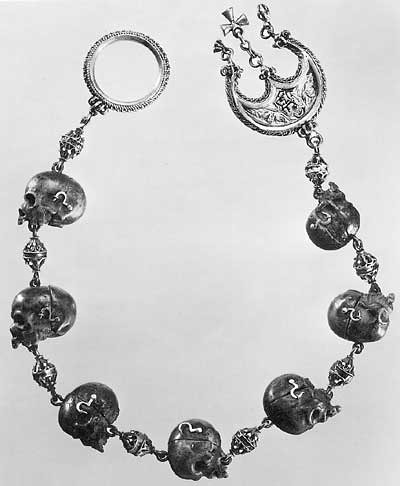
There is also one splendid string of seven skulls (almost certainly ten originally), which dates from the 16th century. It's now in Germany, but almost certainly comes originally from Mexico. The skulls open into two halves, and inside each half is a miniature religious scene carved in boxwood, with a background of iridescent feathers -- a type of work almost unique to the Spanish colonies in America.


Those are, rather surprisingly, the only historical contexts before the 19th century in which I've found skulls attached to rosaries.

So I was fascinated with an antique-looking rosary using small skulls for marker beads or "gauds" that appeared on eBay a few years ago -- with very little information attached and at a very high price. The skull beads, which looked to be about half to three-quarters of an inch in size, were gilded silver, each with two tiny rubies set in it as eyes. The cross attached was not a crucifix, but of a type I've seen in a 17th century context. I saved the photo because it was so intriguing, and I still wonder whether it was really that old or whether it was a later piece (perhaps from Mexico).


I am also still kicking myself about another eBay find. Someone was selling an entire chain (about 20) of hand-carved wooden beads showing a Christ head on one face and a skull on the other. I can't imagine they were any older than 19th or 20th century, but they were well done and looked as if they had just walked off the page of a museum book:

Wooden skull bead

Unfortunately I didn't have the couple of hundred dollars the seller wanted for the whole string, and he wasn't selling the heads individually. I should have taken the plunge and invested in them. I probably could have made a good profit.

There are some fairly good little "skull" beads in the half-inch range out there for sale, usually of bone. (There are also some really terrible ones.) I found a whole string of good ones, and, taking a few liberties with the historical evidence, here's a rosary I made for a friend of olivewood beads with bone skulls as the gauds:

Olivewood rosary with skull gauds

Posts in this series:


Death's head devotions
Skully bits
Skulls: the inside story
Skulls: the inside story, part 2
Skulls: the inside story, part 3
Voldemort
Voldemort, part 2
A skull of one's own
Goth
More living color

Labels: ,

Monday, December 27, 2004

Chatsworth paternoster

I finally have a GOOD photo of the "Chatsworth paternoster," otherwise known as Henry VIII's rosary.

It's actually a "tenner", a string of ten large beads. There is a ring at one end, a cross, the usual ten beads, and then an eleventh, larger bead which is a "prayer nut," carved on the outside and opening to show more carving on the inside.

Actually, the whole thing is an amazing, minutely and intricately carved work in boxwood -- a wood often used for such virtuoso exhibitions of carving, since it's very hard and close-grained. To quote the catalog:

"The Cross is carved with the Crucifixion and the Four Evangelists on one side and the four Latin fathers on the other. The Ave beads are each divided into five roundels, and carved with figures of ten of the the Apostles, with the Sentences of the Creed, the Prophets and Sibyls with appropriate texts, and scenes from the Old and New Testaments. The Pater bead [5.4cm diameter] has three rows of eight roundels with further scenes, including the royal arms of England and the letters 'he 8' (for King Henry VIII) and 'k.a.' (for Queen Catherine of Aragon), and the two remaining Apostles; it is hinged and has another two scenes inside of the Mass of Saint Gregory and the Virgin and Child Adored by Angels."

The entire string is 58cm (almost 23 inches) long. It was bought by the sixth Duke of Devonshire (1790-1858) for 200 pounds, from Rundell and Bridge (the Court jewelers), after being in the keeping of the Jesuits at Paris for many years, and then in a private collection.

I've been looking for a good photo of this for quite a while, since the only ones I've been able to find are small black and white versions, and usually they're from books printed before about 1990, when there seems to have been something of a revolution in photography and color printing that allows more recent books to have bigger, sharper and clearer close-up photos than ever before. (People with over-40 eyes appreciate this a lot.)

This photo is in The Devonshire Inheritance: Five Centuries of Collecting at Chatsworth [Ed. Frances Kianka; Art Services International, 2003, ISBN 0-88397-138-0], printed to accompany a traveling exhibit that's been making the rounds in the U.S. (I think it's currently in Palm Beach, Florida). There's a half-page photo of the whole thing, and a closeup of two of the beads.

That's the good news [grin].

The bad news? The fact that this is, indeed, part of that traveling exhibit means that I did -- as I thought -- miss seeing the thing in person by one (1) day. I was visiting my parents in Boston early in November, and the day that I arrived was the day after the last day of the exhibit at the Peabody Essex Museum in Salem, Massachusetts, not that far away.

Oh, well :)

Labels: , ,

Sunday, December 12, 2004

English rosaries after Henry VIII

The inventory of Henry VIII contains numerous entries describing a string of beads "gauded" with some other kind of bead -- pearls gauded with gold, white beads gauded with blue, et cetera. A fellow jewelry researcher has convinced me these are probably all rosaries, especially since the beaded necklaces in her other research are never described this way.

After Henry VIII's break with Rome, the rosary became suspect as a "Popish practice." In particular, the prayers of the rosary were problematic because they invoke a saint, the Virgin Mary. Article 22 of the Thirty-Nine Articles (which define the Church of England) describes the invocation of saints as "a fond thing vainly invented and grounded upon no warranty of Scripture, but rather repugnant to the word of God."

People of a more Puritan way of thinking, of course, regarded crosses, rosaries, the sign of the cross, et cetera as "Popish idols" and universally condemned their use. We have stories of parents snatching their babies out of the priest's arms at baptism in order to prevent him making the sign of the cross on their foreheads!

In 1571, the year after Queen Elizabeth was formally excommunicated by the Pope, a statute was passed declaring rosaries and other Roman Catholic accessories illegal. We have a picture published by Bernard Garter of London in 1579 of "Certaine of the Popes merchandize lately sen[t] over into Englande" which includes two very recognizable five-decade rosaries, along with a rather odd circle of nine striped beads and several plain ones, several religious medals, an "Agnus Dei" (consecrated wax medallion), religious woodblock prints, a pouch of "granum benedictum," and a portable altar.

Bernard Garters contraband

However there are indications that the rosary did survive, at least in areas where Roman Catholicism remained strong, such as the north of England and the southwest (Devon and Cornwall). Dr. Madeleine Gray wrote a couple of years ago that there's a record of a seventeenth-century Puritan clergyman in south-west Wales who was reduced to imploring his congregation to use their rosaries "prayerfully and with thought." I think the jury is still out on whether the rosary continued to be used by members of the reformed English church, although it's certainly possible that otherwise good members of the Reformed church retained some "superstitious" traditions.

A good deal of comment has been occasioned by the discovery in Jamestown (Virginia) of beads that look like they could be part of a rosary. There is an online article about these beads (and others) in The Journal of the Jamestown Rediscovery Center, a refereed online journal. (See especially section 2.2 and endnote 3.)

If you have the time and inclination, you can also download the 1997 Jamestown excavation report, which includes details of a crucifix found on the site which also might have been part of a rosary. It's a 2.3 megabyte PDF file (which requires Acrobat Reader).

See pages 22 and 23 of the file for a description of the crucifix with a photograph, as well as some discussion of a possible Catholic presence at Jamestown and the survivial of Catholic traditions in Elizabethan England.

Labels: ,

Monday, November 29, 2004

Ring around the Rosary

A question I'd had for some time but never had an answer for: How far back do rosary rings date?

The idea of a ring-shaped device with ten "bumps" for the ten Hail Marys seems like the sort of thing that could have been invented any time. But what attracted my attention to the history of the idea was someone selling replicas on eBay a couple of years ago of a supposed "16th-century" English rosary ring. They were only asking a couple of dollars, so I bought one and added it to my teaching collection.

Replica ring from eBay

I didn't find the story the seller was telling very convincing -- he claimed it was "found in a field where in the 1500’s a priest was said to have been hung". Someone who knows a little about the persecution of Roman Catholics in England would begin by pointing out that (1) it wasn't illegal simply to be a Catholic priest in 1500s England, in fact there were plenty of them left over from the old days, still living quietly on their pensions, that (2) active persecution of missionary priests didn't start till well into the 1580s, that (3) when missionary priests were found they were treated as State prisoners rather than simply hung, and (4) anyway that merely finding something in the same field where such a thing happened doesn't mean there is any connection. However.

This still left me looking for historical evidence.

At this point the only actual rosary rings I'd seen were modern. Various styles of modern rosary rings show up pretty regularly on eBay and in religious goods stores. Most of the modern ones look like these:

Modern bronze rosary ring

Modern openwork rosary ring

I imagine they'd be quite uncomfortable to actually wear on a finger, but they're really designed more as something to carry in one's pocket for easy (and perhaps discreet) use. They have an advantage over strung beads in that beads can't possibly come loose or fall off. Sometimes they're referred to as "soldier's rosaries."

Another modern version looks rather more comfortable for actual wearing. I've seen several versions of these as well:

Flatring

A Ringer!

Much to my surprise, however -- considering my skepticism about the supposed 16th-century replicas on eBay -- when I finally had the time to start combing online museum images for period rosaries, the Victoria & Albert Museum turns out to have one, which they date to 1500-1520. Here's a small version of their picture.

V&A-rosaryring

Unfortunately the way the V&A online image collection is set up makes it hard to create direct links, but if you go to http://images.vam.ac.uk/ and enter 775-1871 (the object number) into the Search box, that will take you to the page featuring this ring, where they have some interesting things to say.

Labels: ,

Saturday, October 09, 2004

Rosaries for RenFaire

I actually got interested in the history of rosaries and paternosters in the first place because someone from my Renaissance guild said to me, "The character I'm portraying was a Catholic. Would she have carried a rosary, and if so, what would it have looked like?"

"I don't know," I answered, and started looking for information. Alas, sources are few and far between. For some reason, nearly everyone who writes about rosaries focuses on the prayers, and completely skips over questions like what the beads were made of, how many there are, and how they are arranged.

It turns out that the most useful resources are books on jewelry, since rosaries seem to have generally followed the fashions of ordinary jewelry of the same period. We do have a few surviving rosaries from the 15th, 16th and early 17th centuries, and more evidence from period paintings and other illustrations. What can we conclude from these?

First, 16th-century English rosaries came in a variety of forms, some of which look quite a lot like modern rosaries. The form of the modern rosary, a circle of five groups of ten beads each, with a single bead between "decades" and a short side-chain of five more beads and a cross, was more or less "standardized" by the Council of Trent, which met in the middle of the 16th century, from 1563 to 1569.

Judging from jewelry of the time, it's quite possible to find a modern rosary that is a pretty good approximation of a 16th-century rosary of this type. Here are the major things to look for.

(1) Beads were usually not faceted, but round or oval with a smooth surface.

(2) Materials include -- more or less in order from lowest to highest status -- wood, bone, glass, semiprecious stone such as agate, mother-of-pearl, jet, amber, coral, silver, pearls, or even gold with precious stones. The single beads between decades (called "paters" or "gauds") were usually material of the same or higher status than the decade beads.

Any modern rosary that meets these criteria and doesn't look like it's plastic, machine-made or excessively modern in style is quite a plausible accessory for a 16th-century Catholic. Pay especially close attention to the cross and medals of any rosary you're considering -- this is where modern style shows up most often, and a 1930s Art Deco cross just doesn't make for a believable 16th-century accessory.

I'll write more another day about other types of 16th-century rosaries, but briefly, we also see rosaries that are strung on silk thread rather than being made with metal chain-links like modern ones, circles of five decades with just a cross rather than the whole side-chain, and rosaries that end with a religious medal or plain cross rather than a crucifix (a cross with the figure of Jesus on it).

How would a 16th-century Catholic have worn or used her rosary?

Rosaries were technically illegal in Protestant England, but as far as I know, the extent of active persecution of Catholics was actually rather limited, and in any case only significant after the 1570s. Nobles and gentry who refused to attend the parish church were subject to fines, and occasionally someone of significant social standing who had been reported as a Catholic (often by disgruntled neighbors or rivals) was put in jail to think about it for a while, but really active persecution was mostly confined to the politically suspect -- priests actively trying to win converts and anyone suspected of plotting against the Crown. So an ordinary Catholic would probably not get into any trouble just by openly carrying a rosary.

Probably most rosaries were carried in a pocket, as they usually are today. A rosary might also have been worn as jewelry -- in the 16th century it was not considered sacreligious to wear a rosary as a necklace, or it might be wound around the wrist to wear as a bracelet. (Be aware, though, that wearing a rosary as a necklace is considered shocking or irreverent by many modern Catholics, so if you choose to do this, prepare to deal with the audience's reaction.)

A rosary could also be worn hanging from one's belt -- there's at least one portrait of Mary Queen of Scots that shows her wearing one in this style.

The rosary was and is a form of private prayer, so you would not find people standing around reciting it loudly in public. It also doesn't seem to have been such a "hot" issue that you would expect someone to walk up to you in the street and denounce you for having or using one -- any religious attacks were more often about "Papist practices" in general, rather than rosaries in particular.

You might well, however, find someone sitting or kneeling with one off in a quiet corner, or in the back row at a prayer service. If you want to be completely historically accurate, by the way, you would probably be reciting the prayers in Latin -- available online at http://rosarycreations.com/rosaryprayerslatin.htm among other places, along with general instructions on which prayers to say when. (Googling on "rosary prayers Latin" turns up quite a few sites.)

A few pictures of 16th-century rosaries online:

Small rosary of bone, 15th-16th century. (Re-strung in modern times.)

Wood and silver rosary, strung on silk cord, 16th-17th century.

Rosary belonging to Mary Queen of Scots

Portrait of the 63-year-old Erhard Vöhlin von Frickenhausen, 1552

Portrait of a Young Man (Balthasar Eicheister) with Pomander by Bartholomeus Bruyn, the Elder.


Holbein's portrait of Lady Mary Guildford (1527)

Labels: ,