Saturday, April 05, 2008

More living color

I noticed my "travelogue" was getting a bit lengthy, and I still had more to say, so here's the continuation.

I went to Mass on Easter morning in the Kölner Dom (Cologne cathedral), with the Cardinal Archbishop presiding (this being an opportunity that doesn't come along every day!). It was, as one would expect, quite beautiful, and also FREEZING cold. I don't know whether the building simply doesn't have heat (after all, none of them did in the Middle Ages) or whether it simply can't be used at the moment because of current construction. (And I didn't have that essential medieval winter accessory, a brazier, with me ;) My German isn't good enough to follow much of what the Archbishop said, but I believe he did apologize for the cold.

But since this was, after all, mainly a research trip, I spent the afternoon of Easter Sunday in a museum.

I was very happy with my visit to the Schnütgen Museum, which is nicely settled into its new home in another former church (Saint Cecilia), though they are still working on the attached new building that will eventually give them a much expanded display space.

As it is, it is an utterly amazing place. (There's a photo on their web page in the link above.) Dozens of medieval wood sculptures, many rescued in the late 19th century from church attics and basements, sit right out in the open where you can practically walk right up and put your nose against them to see all the details (though no doubt state-of-the-art security alarms would go off if you actually touched them). Since I was there on Easter Sunday afternoon, I very nearly had the entire place to myself -- I think I saw perhaps four or five other visitors in three hours.

Down in the crypt -- again, the very last display room -- I was glad to see the rosary displayed that I had particularly hoped to see. It's the chain of seven skulls from 16th-century Mexico that I discussed in some detail a couple of years ago.

It's really a shame that the museum hasn't published big, gorgeous color pictures of this rosary and all its parts. The only photos I could find when I wanted to talk about this earlier were black and white catalog photos from the Marburg Foto Index (informally known as "bildindex") and they are not very clear. This piece is also featured in the 2006 exhibit catalog Zum Sterben schön : Alter, Totentanz und Sterbekunst von 1500 bis heute (which translates roughly as "Beautiful Death: Age, the Dance of Death, and the Art of Death from 1500 to today"), but again, there's only one photo of the whole string, and not a very large one.

There's more than one reason to wish for big photos. As you'll remember if you read the previous series, each of these skulls opens to reveal two tiny panels, each showing a religious scene carved in boxwood, a very dense wood that allows very fine detail carving. You can see the Marburg photos of a few of these scenes here. (Keep in mind that each skull is perhaps an inch high!) I did not have time before I left to slog through a complete translation of the discussion of these scenes in Zum Sterben schön, but from a quick look at it, I suspect I disagree with some of their conclusions as to what these scenes represent.

The other reason I wanted some better photos is purely artistic. There is an entire genre of these tiny devotional boxwood carvings. One of their outstanding features is that many of these scenes have a distinctive background, painstakingly constructed from bits of iridescent blue feathers. This in fact is one of the clues that leads art historians to conclude that these pieces came originally from Mexico, where native traditions such as featherwork combined with the new arts introduced by the Spanish to produce some astonishing works of art.

Black and white photos just don't convey this adequately:

Skull 01 black and white

But because I was there in person, I was able to get a whole series of photos that let us admire these now in all their glory.

Skulls in color: 2

Skulls in color: 3

Skulls in color: 4

Skulls in color: 5

Edited to add: As a bonus, the Metropolitan Museum of Art in New York is currently featuring an exhibition of Native American feather work called Radiance from the Rainforest: Featherwork in Ancient Peru, which is well worth looking at, even just the online images.

Pictures from Köln:


In living color
More living color
A Joos van Cleve altarpiece
Details, details

Labels:

Tuesday, October 31, 2006

The place of the skull

I figure Hallowe'en is a good day to talk about skulls. I did quite a series of posts about rosaries and skulls last year -- you can look them up in the September and October 2005 archives if you're interested. But I promise just the one post this time.

I find that I do a certain amount of debunking of myths on this blog, and I've run across one myth about skulls that I'd like to mention. Every so often someone on eBay discovers that the rosary they have to sell has a crucifix with a skull at the base, like this one:


Not uncommonly, the seller gets very excited because they think this is a rare thing or an indication of great age -- after all, they have never seen one like this. They may also think it's an indication that the rosary was owned by a priest or nun, since the idea of nuns meditating on skulls, graves, etc. (and the imminence of death) has lingered from Victorian "nun horror" literature right up to the present.

(There's a whole genre of Victorian horror literature, with titles like "The Awful Disclosures of Maria Monk," about torture, sex, and slavery supposedly going on in convents. The books are generally so bad they're laughable, though occasionally one runs across an uninformed reader who actually believes they're true.)

At any rate, crucifixes that show a skull at the base are actually not all that rare, and neither are they confined to rosaries made for nuns. I think they're somewhat more common in Hispanic cultures now, but it's something that was quite fashionable in many parts of Europe during the Renaissance. As I went into some detail last year about the popularity of skull imagery in general, I won't repeat myself here, but they show up in a surprising number of places.

A skull at the base of a crucifix, however, bears a special message. This is based on a piece of common European folklore about the Crucifixion. Legend says that the place where Adam died and was buried in the Garden of Eden later became the hill where Christ was crucified. (Modern geographers think that if there were actual places that inspired the Garden of Eden, they were elsewhere, but thus goes the legend.)

Further, according to the legend, the Cross on which Jesus was crucified was actually made from the wood of the Tree of Knowledge in the Garden of Eden (therefore, presumably, an apple tree, if you think the fruit Adam and Eve ate was an apple).

So a skull at the base of the Crucifix represents the skull of Adam. Since Jesus, who redeemed humanity, is sometimes seen as the "new Adam" -- reversing the Fall, the Redemption gave humanity a fresh start of sorts -- it's entirely appropriate to pair him with the "old Adam" in this way.

And in case anyone didn't learn this in Sunday School, the name of the hill, Golgotha, where Christ was crucified, actually does mean "place of the skull."

There's a very clear skull and crossbones is at the foot of this gold enameled cross from the 16th or early 17th, which I think I've referred to on this blog before:

X-skull-1

I must admit that the accidents of painting and molding make this skull look rather like a walrus, close up. But as you'll see below, the skulls -- in much the same way as angels carved on gravestones -- can become simpler, more stylized and eventually quite abstract looking. In the crucifix below, the jaws of the skull are simply represented by three white dots, standing for "teeth":

X-skull-2

And here, the "skull" has become just a roundish flat piece of metal with a few slashes cut into it:

X-skull-3

You can see a bit more detail on some similar pieces at the Rosary Workshop Museum page on older European crucifixes.

Rosary Workshop, by the way, has added a lot more material and done considerably more editing on their "museum" site in the last couple of years, making it much more solid and better documented. I do still see minor typos on a fairly regular basis, and some incorrect information that has not yet been checked or removed (such as the unfortunate"knock on wood" story -- language historians point out that it contradicts a number of known facts). But on the whole it's a great improvement.

Posts in this series:


Death's head devotions
Skully bits
Skulls: the inside story
Skulls: the inside story, part 2
Skulls: the inside story, part 3
Voldemort
Voldemort, part 2
A skull of one's own
Goth
More living color

Labels:

Monday, July 31, 2006

Tickling the ivories

One of the bits and pieces from my England trip in March that I've been meaning to talk about is this one, which I saw in the Victoria & Albert museum during my flying visit there.

IVORY_31

This is labeled as a 15th- or 16th-century French rosary, and is made of ivory -- and so far at least, it hasn't turned up in the V&A online database when I've looked for it, which means I really don't have any more solid information on it.

A couple of comparable single beads do turn up when I search on "ivory" or "rosary." (I think I discussed at least one of them in the Voldemort posts last fall.) Unfortunately those don't have much information attached either, just notes that they are 16th century and might be German or Flemish.

As a set of rosary beads, the imagery of this piece is rather odd to modern eyes. The only two motifs I can find that are unambiguously religious are the two flat plaques, one clearly showing a haloed saint holding a chalice and communion bread, and the other showing a man in a three-tiered tiara, who I assume represents a Pope.

Two-shrines

The wreathed head at the bottom looks more like the head of a Roman hero than like that of a contemporary European, and it certainly doesn't have any of the distinguishing characteristics that would make it a head of Christ.

However I think we begin to get some glimmerings of understanding when we see that the reverse of this bead is a skull. A living head on one side and a skull or cadaver's head on the other is a fairly common Renaissance motif, referred to as "memento mori" (Remember Death).

Wreathed-head

The rest of the beads look quite secular.

Ivory-3heads

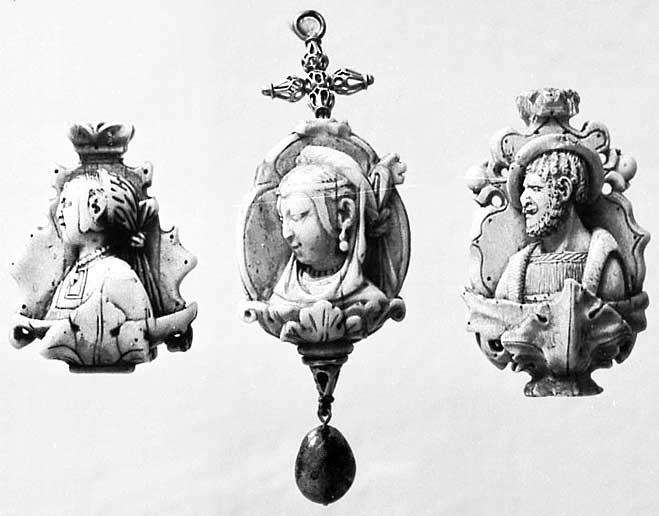
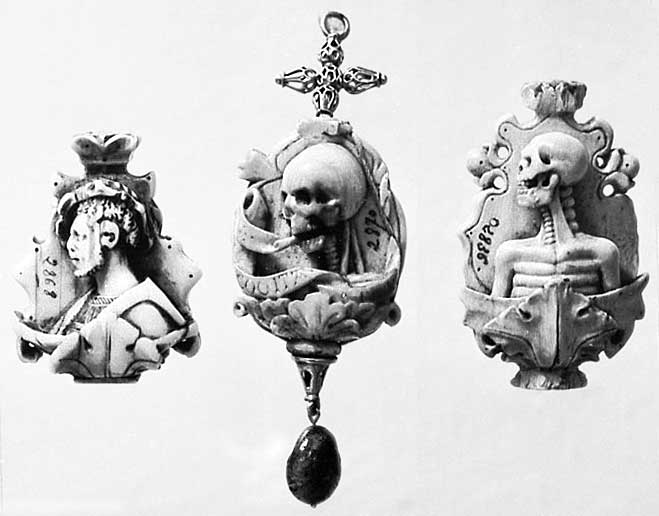
Last fall's "Voldemort" series of posts showed this somewhat comparable set of three beads (front and back). They are clearly related to each other, but two have skull or skeleton features on the back, and the third does not -- it's a man on one side and a woman on the other, but both representations of living people.

So one possibility is that in the V&A piece we are seeing, by accident or design, a set of beads that are related to the "memento mori" designs -- but in this case, all living faces, mostly without skulls.

Three MI01600c08a
Three MI01600c09a

Another possibility is suggested by this bead (both sides shown). This is also from the V&A but was not on display when I visited.

3041-VA

The fact that one side shows a woman with what appears to me to be a man's head on a plate suggests to me that this is supposed to represent Salome, with the head of John the Baptist. If this is a Biblical reference, the king on the other side could represent Herod. While none of the "secular" heads on the V&A rosary carry symbols that I can see, it's possible they may represent Biblical characters as well.

Seeing Biblical personages in 16th-century dress should be no surprise, as we have abundant examples of that in other forms of art in this period, including paintings and needlework pictures. In modern times, we almost always see Bible characters in conventionalized "robes" (which may or may not have anything to do with what they really wore in 1st-century Palestine!) and so it takes some effort for us to recognize these people in a 16th-century disguise.

I'm not completely satisfied with this explanation, however. I can't help wondering whether anyone has done a comprehensive study of this type of carved ivory "bead" to discover how they were actually made, regarded, and used in the 16th century.

Some of them, clearly, like the middle beads here, were designed as part of a "set" since they have matching decorative elements at top and bottom. That suggests they may indeed have been strung in sequence as we see here -- though whether for use as a rosary, or simply as a decorative necklace, I don't know. (If the Art Nouveau movement could make jewelry with stylized ladies' heads on it fashionable, without it meaning much of anything, Renaissance art could certainly do the same.)

But often one of these little ivory carvings will appear in a collection as a single item, not obviously related to anything else. Like other "precious" artifacts, these beads seem mostly to have been passed down from collector to collector for their artistic value, but not necessarily with any solid information on where they originally came from. We might know a lot more about them if they had come from a grave or archaeological dig, where we could see what they were lying next to.

Because they are assumed to be "rosary beads", I suspect restorers have been quick to take a group of them and arrange them into a "rosary", but I wonder how much evidence there is that this is how they were originally used. I have certainly seen at least one string (here) that is clearly made from beads from two or more different sources, and I can't help wondering if this V&A example is another.

Posts in this series:


Death's head devotions
Skully bits
Skulls: the inside story
Skulls: the inside story, part 2
Skulls: the inside story, part 3
Voldemort
Voldemort, part 2
A skull of one's own
Goth
More living color

Labels: ,

Monday, October 31, 2005

Goth

Modern "Goth" culture echoes, in some ways, the fascination in past centuries with the imagery of death, although the meaning is now rather different.

In the Middle Ages, skulls and skeletons were gruesome and frightening, but they were also seen as symbols of the intent to live a good and holy life and attain heaven in the limited time available (or perhaps through Purgatory later).

But in modern times, skulls and skeletons lack these positive associations, and are seen solely as symbols of fear, despair, suffering and evil.

Some modern "Goths" do embrace not only the black clothing and pale makeup, but a "Goth" attitude. For them, the skull-and-blood imagery, and the mockery of religious symbols such as crucifixes and rosaries, expresses their genuine feeling of alienation, sadness and hopelessness.

More often, though -- and this is why I'm writing this on Hallowe'en -- the "Goths" and "pirates" I encounter are tongue-in-cheek. They enjoy wearing the clothes as an outrageous fashion statement, and get a kick out of pretending to be evil and out of making fun of those who take life too seriously. They are not out to actually hurt anyone, and in fact, many of the ones I've met are extraordinarily kind and helpful people behind the silly or outré masks.

Unfortunately this playful sort of "Goth" is sometimes mistaken for someone genuinely interested in evil. As Joe Sinasac comments at Catholic Online, it's easy to focus on "Gothic beasties and so-called black magic", when real evil is much more mundane. "As Hannah Arendt observed," he adds, "evil is often banal, not exciting... Such fears are echoes of past alarms over the Halloween custom of dressing up the kids as goblins and witches. They make just as little sense. Real evil can be much more difficult to detect – and is far more widespread. Also much more difficult to eradicate; a simple exorcism just won’t do."

So the imagery doesn't scare me. I'm more amused than horrified by the "goth" rosaries I've encountered. (Though I can understand how others might see hostility where I see humor, and if so, they're certainly entitled to that opinion.)


Just as with real rosaries, there are tacky and flimsy goth rosaries and there are nicely-constructed ones. Also, just as with real rosaries, there are examples that stick fairly closely to the "canonical" construction of modern rosaries, and there are also variations that don't. I expect most of those (like the one below) are due to an artistic impulse to interpret the design loosely, though I suspect there are a few out there whose makers are simply unclear on the concept. :)


The site that keeps coming up in a Google search for "goth" and "rosary" (and source of the above images) is, unsurprisingly, Goth Rosary, which does have some interesting merchandise, including not only rosaries named after blood types (Type A, Type O, Type AB negative) but "coffin" purses and fragrances with names like "Graveyard" ("The smell of rich loamy soil, fresh green grass with a note of floral..") and "Mayhem" ("The smell of smoke mixed with woods & spice...."). I think my favorite is the bone-colored skull comb.

(By the way, my research also turned up an interesting online article on the history and anthropology of modern "goth" culture (originally someone's term paper) that I found well worth reading.)

Posts in this series:


Death's head devotions
Skully bits
Skulls: the inside story
Skulls: the inside story, part 2
Skulls: the inside story, part 3
Voldemort
Voldemort, part 2
A skull of one's own
Goth
More living color

Labels:

Friday, October 21, 2005

Coffins

We seem to be getting a bit far afield from rosaries, but considering the interesting phenomenon of rosaries that use skulls (as they occasionally do) leads naturally to consideration of the other skull and skeleton "keepsakes" that are relatively common in the Middle Ages and Renaissance. Especially since it's October :)

Another such "memento mori" object is the miniature coffin, which often opens to show a skeleton. Probably one of the better-known examples is the so-called Torre Abbey jewel from England (1540-1550, museum no. 3581-1856), now in the Victoria and Albert museum.

Torre Abbey

The point of having such a memento was that by remembering that death was inevitable and unpredictable, you would be motivated to live a virtuous life. This continued to be fashionable right through the 16th century.

Another example from the Victoria & Albert, which is rather more decorative with a fancy chain decorated with pairs of crossed bones, and colored black and white with enamel, is this one:

Skull-coffin

The museum's commentary notes that by the middle of the 17th century, the focus of skull, coffin and skeleton symbolism had changed -- from an abstract contemplation of death as motivation for virtue to commemorating the deaths of specific people, generally family members or loved ones.

The fashion began to turn then from memento-mori's toward mourning jewelry, with dates, initials or names, and eventually to such things as Victorian "hair jewelry" made from hair from the deceased. The impulse to create "relics," in the same way the Middle Ages treasured bits of hair, bone or clothing from saints, seems to be a recurring theme. Popular symbolism also turned from skulls and coffins toward weeping women, willow trees, gravestones and broken columns as symbols of loss.

But we are still in the Middle Ages in this discussion, and I found another very interesting coffin while roaming around in the Marburg Index, which I thought I'd share. Here is an overview:

Coffin

According to the museum notes, this is ivory, from Western Switzerland around 1520. Like most of the memento-mori's I've been discussing, it's now in the Schnütgen Museum in Köln (Cologne), Germany. The skeleton is enclosed in a "box" composed of a solid base and lid in a rather eye-blinding black-and-white pattern, and open sides with narrow columns and wide spaces.

What's particularly notable about this one is that the skeleton isn't completely reduced to bones, but retains some "muscle tissue"(?) depicted in ivory on the top side, and through a hole in the stomach some "internal organs" can be seen.

Coffin-skel

I suppose ivory is such a wonderful material that it manages to make even such revolting details look eerily beautiful, but my modern sense of appropriateness still says "Eeeeeuuuuwwwwwww!"

Posts in this series:


Death's head devotions
Skully bits
Skulls: the inside story
Skulls: the inside story, part 2
Skulls: the inside story, part 3
Voldemort
Voldemort, part 2
A skull of one's own
Goth
More living color

Labels: ,

Friday, October 07, 2005

The dancing skeleton

I will get off this "skulls" thing I've been on: really, I will. But there will be just a few more posts -- October, with Hallowe'en and the Day of the Dead at the end of it, is just too good an opportunity to pass up.

One of my correspondents pointed me to an intriguing little "dancing" or "climbing" bone skeleton bead that's available from Fire Mountain Gems. It's a bit better carved than some of the bone skulls they sell, and I think it's rather cute.


I actually found a somewhat similar (but smaller) metal version, which I've used on the "plain and simple" version of a rosary in red glass in my collection.


Finally, there's another delightful little "Memento Mori" carving in the form of this "dancing skeleton." It's listed as possibly from Berlin, attributed to Joachim Hennen in the middle of the 17th century, and is now with the other "Voldemort" memento-mori's in the Schnütgen Museum in Köln (Cologne).

Dancing-skeleton

It's quite graceful (for a skeleton) even if the whole idea of "skeleton as dress accessory" is a bit morbid!

I should add, by the way, since this is as good a place to mention it as any, that there's also a delightful little ivory carving of a child in the same collection:

Lorettokindl

It's labeled as a "Lorettokindl," that is (I think), a depiction of the Christ Child from a group representing Our Lady of Loretto. I think it's darling. The similarity in poses is intriguing.

Posts in this series:


Death's head devotions
Skully bits
Skulls: the inside story
Skulls: the inside story, part 2
Skulls: the inside story, part 3
Voldemort
Voldemort, part 2
A skull of one's own
Goth
More living color

Labels: ,

Wednesday, September 21, 2005

A skull of one's own

When someone pointed me to Sapphire & Sage's rosary page recently, I was a bit startled -- but pleased! -- to see a familiar image. Rhonda, who's also on the Paternosters mailing list, has made her own copy of that skulls rosary we've been discussing here, and is offering copies for sale as well.

I seem to have been more lucky than most people: for my copy of this rosary, I just happened to walk into my local bead store when they had a bunch of 1-inch skulls hand-carved from peach pits in stock. These are nearly the same size as the originals in the 16th-century rosary, though of course mine don't open into two halves with little carved boxwood scenes inside! I promptly bought ten of them and have never seen them anywhere before or since (till this week: see below!).

I thought I'd take a look around and see what kinds of skull beads are available for others who might want to replicate this rosary. Disappointingly, most of the ones I can find seem to be only about half the size of mine, and they vary widely in quality and style. Most of the skulls I found were bone, though I've also seen them in wood and pewter.

Bone skulls in the half-inch size range seem to be the easiest to find. The good thing about these is that they're usually fairly cheap, running from 10 cents to 30 cents each or thereabouts. They often come as ready-made strings of 108 (the number in the most common type of Hindu prayer beads).

Most are not very realistic looking, such as Shipwreck Beads item #52BS153. The other big online bead source, Fire Mountain Gems has something similar, currently for a much better price (but you have to buy the whole strand). An especially fun place to shop, South Pacific Wholesale Company (despite the name, they do sell retail) also has these. (The catalog from this place is a hoot!)

I wouldn't buy skull beads without seeing a good photo, because there's an even more abstract and less realistic style out there as well -- basically two holes for eyes and a slit for the mouth, or else a very schematic face with the mouth just scratched in, and roughly cross-hatched to represent teeth. This seems to be an Asian style. Shipwreck has very small (10mm) ones as item #68BS153 (25 for $3.65) and I've also seen larger ones of this type, such as Shipwreck's item #94BS156: 1 inch tell, $1.60 each.

Aside from the big bead companies, skull beads tend to be found at places with titles like Pyrates of the Coast, or else at "Goth" sites such as Goth Rosary.

(By the way, I personally see a lot of the "pirate" and "goth" cultural thing as an amusing take-off on religion. But some may see it as hostility to religion, in which case you'll have to decide whether you want to shop at such places or not. More on this another time....)

If you're willing to pay more, there are some better types of skull beads out there as well. Just on a quick search, I found several at a place called Spiritcrafts: pewter skulls (14 x 10mm, drilled side to side, $1 each), some much cruder black glass skulls (13mm, 80 cents), and some rather cheerful ceramic skulls (19x10mm drilled side to side, $1 each).

Last but not least, I did find peach pit and boxwood skull beads, but unfortunately, only from wholesalers. With minimum orders like $1,000 or a full cargo container, this isn't practical for most of us!

* * * * * * * * * * * * * * * * *

P.S. That's where the first draft of this post ended. The next day, my phone rang and it was a friend calling on her cell phone from a bead show. "They have some nice skull beads here," she said, "Want some?" and she described them. I said yes, and though I haven't seen them yet, they certainly sound like what I was seeing wholesale. So perhaps bead shows are the best place to find skulls of one's own!

Posts in this series:


Death's head devotions
Skully bits
Skulls: the inside story
Skulls: the inside story, part 2
Skulls: the inside story, part 3
Voldemort
Voldemort, part 2
A skull of one's own
Goth
More living color

Labels: ,

Saturday, August 13, 2005

Voldemort II

As I mentioned a week or so ago, some of the small ivory sculptures I've been running across remind me of the character Voldemort in the Harry Potter books -- whose name, incidentally, contains the Latin root "mort" (death).

Head MI11903b04a

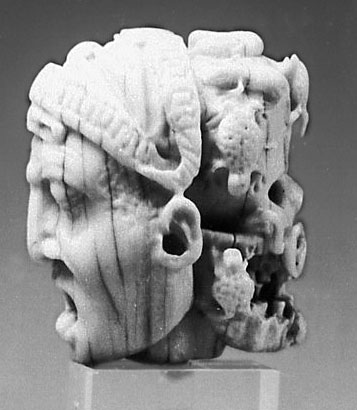
Usually these little ivory sculptures -- called "Memento Moris" -- have a living person's face on one side and a grinning skull on the other. Most of the ones I've seen have some arrangement for stringing as pendants -- either an attached ring at the top or a vertical hole bored through them.

(Here's a closeup of the skull side of the example above.)

Skull-132 MI11903b03a

I don't have a lot of data on how these were actually used or worn -- they are almost always described as components of a rosary or paternoster, but I haven't seen any pictorial or documentary evidence of them being used that way. (Rosaries like the one in my first post are usually reconstructions.) I would be unsurprised to see them on, for instance, a watch chain or somewhere else that a small hanging decorative object would be used. These remind me strongly of the Japanese netsuke, similar little sculptures that have become a "hot" collectible art form.

Like any other expensive little accessory, these were probably worn as much to show off one's wealth and good taste as for any other reason. However they do have a serious spiritual purpose: as their name indicates, these are reminders that death comes to everyone ("memento mori" = "remember death") and that since it may be unexpected and sudden, being prepared for it spiritually is a good thing.

(Note that the left-hand one of the three below does not actually have a skull -- it has a man's face on one side and a woman's on the other. This makes me wonder whether some of these faces may be actual portraits of the owners rather than generic faces.)

Three MI01600c08a

Three MI01600c09a

I also suspect that, in the days before today's mass media, these gruesome little pieces catered to the same macabre taste as the popular "dance of death" murals -- the most popular one was in Paris -- and paintings and engravings showing a skeletal Death taking the hand of bishops, aristocrats, nuns, and ordinary people. Perhaps it's the same taste that leads modern people to watch vampire movies :)

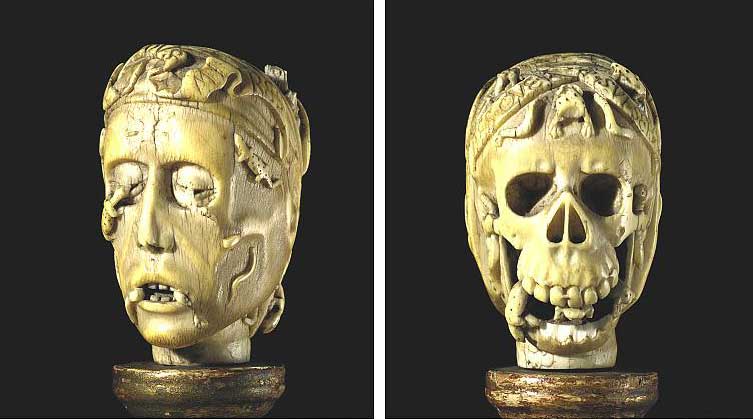
(I've noticed worms and other creepy-crawlies on the "skull" side of several of these sculptures. This especially gruesome example has them on the "face" side as well. Eeeeeeeuuuuuuwwwwww!)

Sotheby-skull

Posts in this series:


Death's head devotions
Skully bits
Skulls: the inside story
Skulls: the inside story, part 2
Skulls: the inside story, part 3
Voldemort
Voldemort, part 2
A skull of one's own
Goth
More living color

Labels: ,

Thursday, August 04, 2005

Voldemort

I admit it: I'm a Harry Potter fan. You'd think this would have nothing to do with medieval rosaries, wouldn't you?

However, while again cruising the Marburg Foto Archive, I ran across some horridly fascinating little ivory sculptures that immediately put me in mind of Voldemort.

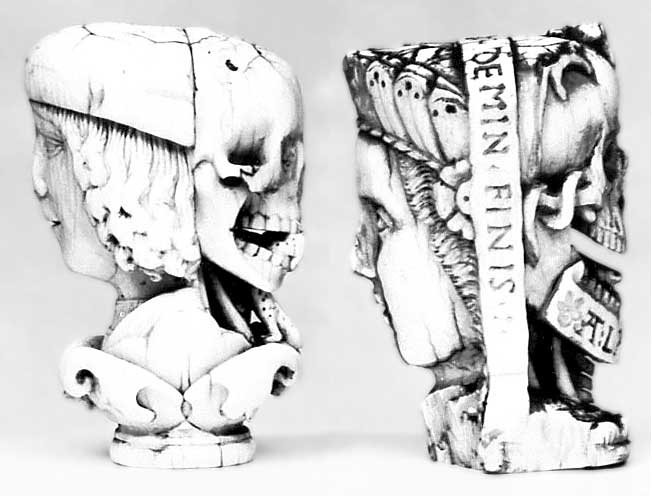
Mori sideways

I'd seen these two pieces before: they're featured in 500 Jahre Rosenkranz, the 1975 exhibition catalog from Köln (Cologne). This is a type of little sculpture called a "Memento Mori", which literally means "remember death." On one side is the face of a living person, and on the other, a skull -- frequently a grinning skull!

(For those who haven't read the Harry Potter books, the first appearance of the villain, Lord Voldemort, is as a disembodied face on the back of Professor Quirrell's head. This is not the only place where author J. K. Rowling is drawing on the vast store of traditional European story-motifs, some of them quite old indeed.)

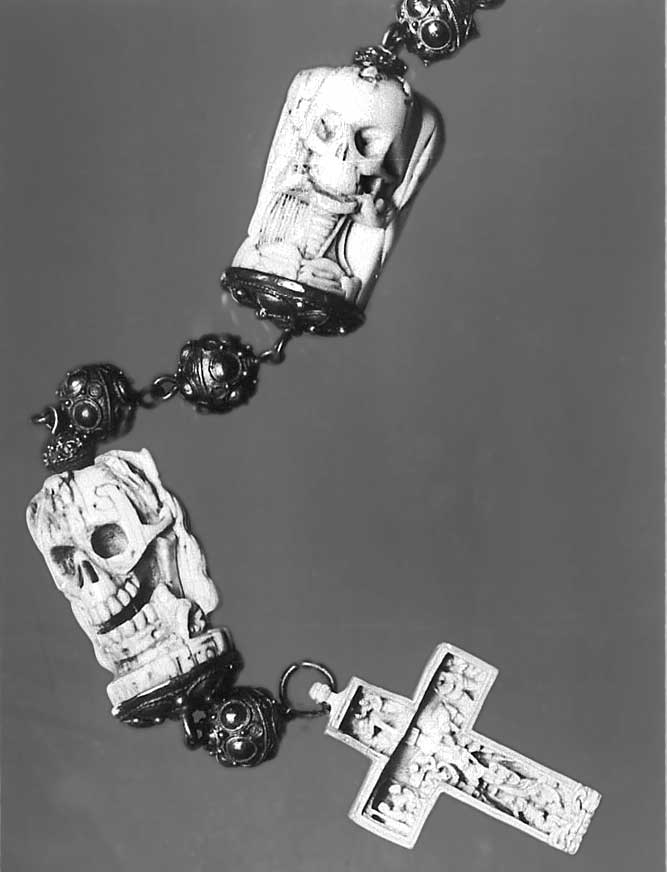
Medieval skull imagery is not something I deliberately set out to investigate, but I'm intrigued by how I keep tripping over it anyway. In the same collection as the two sculptures above, I ran across an entire string of little Memento-moris that have been formed into a sort of rosary. These pieces are in Köln, but while most of the rosaries in Köln's famous collection are in the diocesan museum, these are from the Schnütgen museum across town.

Memento-mori string
Mori-string 1

To me this does not appear to be an actual rosary. The arrangement doesn't particularly make sense -- why is the extra cross between two beads, rather than at the end? Why are there two beads between some sculptures and only one between others? I strongly suspect that, like the filigree beads I mentioned earlier this week, this originated as a bunch of loose pieces that someone has made into a string.

Mori-string 2

The top bead in particular does not look to me as though it's done in the same artistic style as the others. It's also the only one of the five without a skull: it appears to have a man's face and a woman's back to back, presumably Jesus Christ and the Virgin Mary. The other four ivories are much more worn down and seem to be much less meticulously carved. The carved cross at the bottom and the metal beads may or may not have had anything to do with the other pieces originally.

There are several more of these Memento-moris at the Schnütgen museum, and we'll take a closer look at them soon.

Posts in this series:


Death's head devotions
Skully bits
Skulls: the inside story
Skulls: the inside story, part 2
Skulls: the inside story, part 3
Voldemort
Voldemort, part 2
A skull of one's own
Goth
More living color

Labels: ,

Wednesday, July 13, 2005

Skulls: the inside story part 3

In Skulls: the inside story and in Part 2 a couple of days ago, I introduced an interesting 16th-century paternoster made of skulls and described the tiny scenes carved inside each bead. I've been thinking about what's there and what's not, and how the (presumably) ten skull-beads of the original might have been arranged before some of the parts were lost.

The Last Supper is such a crucial scene in the life of Christ that it's hard to imagine it not being part of a series of scenes from his life. Similarly, I would expect the Crucifixion and the Resurrection to be included. Perhaps these three were removed to be "recycled" in some other context?

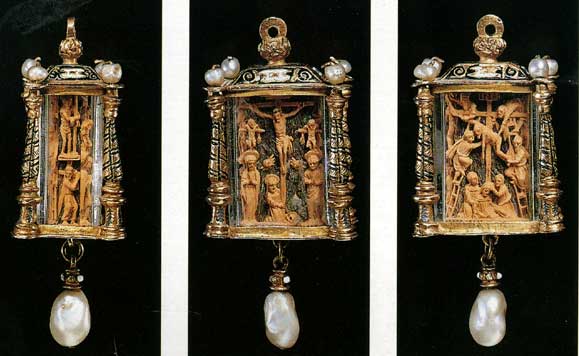
Boxwood pendant

As I've mentioned, we also see these little Mexican carvings used in devotional jewelry, like the pendant shown above, and sometimes to decorate church vessels of one sort or another. These scenes in particular are fairly self-explanatory and could well be used alone.

Here's my guess at the missing parts.

As I've hypothesized it, we have the washing of the disciples' feet in 4a, and a logical place for the Last Supper would be 4b.

Skulls 5 and 6 would have the preliminary Passion scenes: Jesus praying on the Mount of Olives, the kiss of Judas, the scourging and the crowning with thorns.

Another scene that might be missing -- it's the only missing one among the five "Sorrowful Mysteries" that are part of the rosary meditation -- is Christ carrying the cross through the streets. That could be 7a, and the Crucifixion (why is that such a hard word to type correctly?) could be 7b.

This would put the Pieta in 8a, and the Resurrection might be in 8b.

This leaves 9a and 9b to account for. I would guess that 9a would be the Ascension, and if that's so, then 9b would be some sort of triumphal final scene.

Looking at the kinds of scenes that have traditionally been included in the "mysteries" meditated on while praying the rosary, this could be any one of several things. Leading candidates include the descent of the Holy Spirit, the coronation of the Virgin Mary as Queen of Heaven, and the Last Judgement. In some versions of the rosary, the Last Judgement was the last Mystery until it was replaced in later years by the coronation of Mary, due to increased desire to honor Mary and an increasing belief that she was "assumed" into heaven rather than dying in the normal way.

Posts in this series:


Death's head devotions
Skully bits
Skulls: the inside story
Skulls: the inside story, part 2
Skulls: the inside story, part 3
Voldemort
Voldemort, part 2
A skull of one's own
Goth
More living color

Labels:

Friday, July 08, 2005

Elfenbein

More treasures from the Marburg Foto Archive, though the photos unfortunately are not the absolute best they could be.

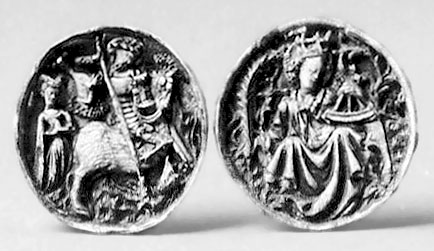
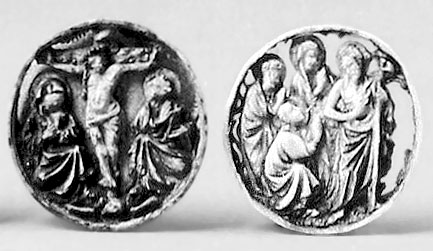
I ran across these while looking for something else, and it occurred to me that this is a good example of how the carved scenes inside the "skulls" rosary we've been looking at might look if they were removed from the skulls.

However these four medallions are ivory, rather than wood. They were originally painted in bright colors, as were most medieval ivories. The plain white appearance of so many ivories today comes from natural wear and from over-cleaning in the 19th century, due to that century's preference for "pure" sculptural forms untainted by color.

While not a lot of German is needed to navigate the Marburg archive, there are certain terms that are useful in reading the museum labels, including the names for various materials, such as "Holz" = wood, "Buchsbaum" = boxwood, "Bergkristall" = rock crystal, and the current "Elfenbein." The word "Bein" means "bone, and for a long while, every time I saw "Elfenbein" it irresistably suggested "elf bones." Actually it's elephant bone, that is, ivory.

These medallions do look as though they come from a set, similar to those in the skulls. The first two are scenes of St. George and St. Catherine of Alexandria. St. George has his spear, his dragon (underfoot), his horse, and at left, the princess he's rescuing. St. Catherine is identifiable because she's holding in one arm a pie-shaped segment of a wheel (you can easily see the three spokes and segment of rim), a symbol of her martyrdom.

George-ivory

The other two medallions in the set are incidents from the life of Christ: the Crucifixion at left, and at right the appearance of the Risen Christ to the women at the tomb.

Jesus-ivory

Labels: ,

Tuesday, July 05, 2005

Skulls: the inside story part 2

In Skulls: the inside story a few days ago, I introduced an interesting 16th-century paternoster made of skulls and described the tiny scenes carved inside the bottom four beads (of the surviving seven).

Here I'll show you the remaining three beads and talk a bit more about what the overall scheme seems to have been.

Skull01

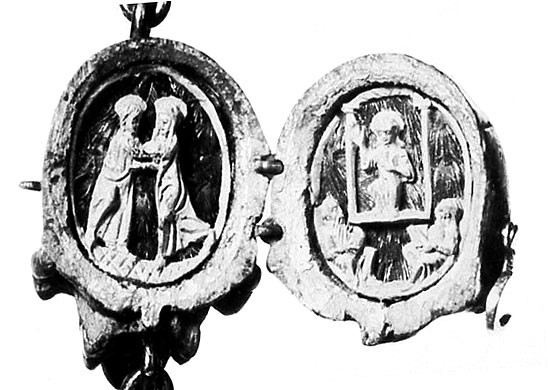
Bead #1 (the top): Inside the front half of the skull (left) is the Visitation of Mary to Elizabeth (the mother of John the Baptist; inside the back half, the museum's description says this is the young Jesus in the Temple in Jerusalem, but I'm not entirely sure of that.

Skull02

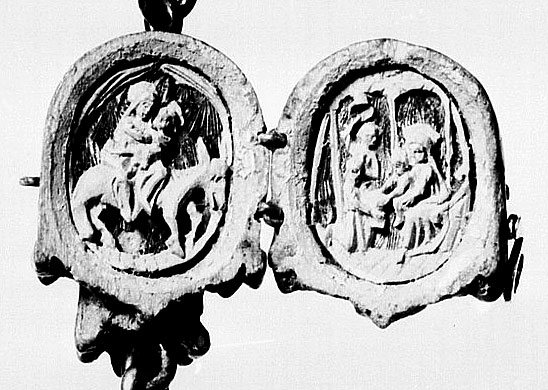
Bead #2: Front, Mary with the infant Jesus on a donkey on their way to Egypt; back, the Adoration of the Magi (which I admit is rather difficult to recognize).

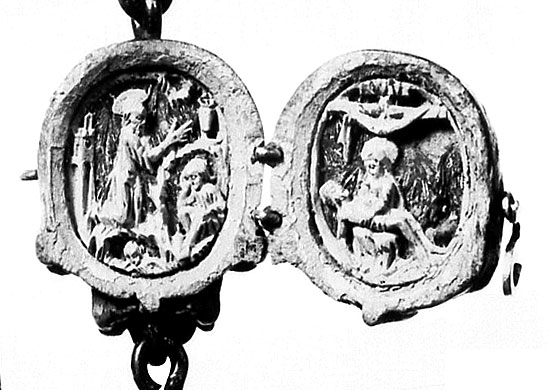
Skull03

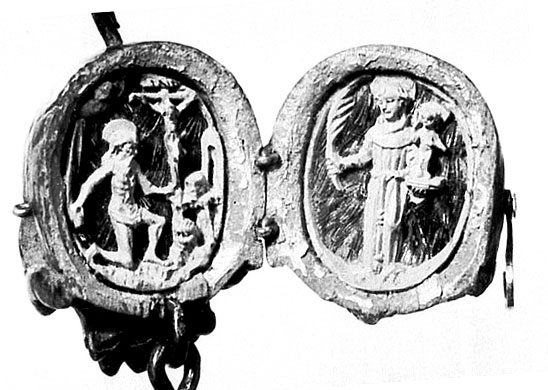
Bead #3: Front, St. Jerome in the desert (identifiable because he's an old man stripped to the waist, beating his breast with a stone); back, St. Antony of Padue (identifiable because he's holding lilies in one hand and the infant Jesus in the other arm).

Links to the full photo in the Marburg Foto Archive, for those who want to see them:
Bead #1 full photo
Bead #2 full photo
Bead #3 full photo

Discussion


What we seem to have here is an incomplete version of the life of Christ, with some extra bits added (such as St. Jerome and St. Antony).

In proper order, the scenes would probably go something like this:

1a. Annunciation
1b. Visitation

2a. Nativity
2b. Adoration of the Magi

3a. Flight into Egypt
3b. Jesus in the Temple (if that's what it is)

If this is correct, the first few beads have actually just had their scenes re-arranged a bit. It's not clear to me, by the way, whether a scene currently in the front half of a skull could be transferred into a back half or not. If not, that puts some restrictions on possible original orders we can reconstruct.

Then it starts to get a little disjointed, probably due to the fact that three skulls are missing, which would hold six additional scenes. Here's my first stab at a reconstruction, with some scenes we don't have inside square brackets []:

4a. Footwashing
4b. [Last Supper?]

5a. Mount of Olives
5b. Kiss of Judas

6a. Scourging at the pillar
6b. Crowning with thorns

(If this is correct, #6 is now the only skull assembled as it was originally.)

7a. [?]
7b. [Crucifixion?]

8a. Pieta
8b. [Resurrection?]

9a. [?]
9b. [?]

10a. St. Jerome
10b. St. Antony

(These last two then being favorite saints of the original owner, perhaps.)

Posts in this series:


Death's head devotions
Skully bits
Skulls: the inside story
Skulls: the inside story, part 2
Skulls: the inside story, part 3
Voldemort
Voldemort, part 2
A skull of one's own
Goth
More living color

Labels:

Sunday, July 03, 2005

Skulls: the inside story

After I posted the note about "Skully bits", a correspondent wrote and asked me whether there were any photos of the tiny carved wooden scenes inside the original string of skulls I was copying.

They're not the greatest of photos, since they're rather old, but yes, there are. Like so much other wonderful stuff, they are in the Marburg Foto Archive, which you've heard me mention often.

A lot of this archive simply consists of the "inventory" photos museums routinely take when they acquire an item, to document its appearance and condition when received. These photos are only as good as the time when they are taken, so many of the older ones (like these) seem badly exposed and poorly focused by today's standards. Also, what we often have online is a photo of the photo, of even lesser quality. But you can still see a lot of useful information.

I've taken the liberty of cropping the originals before posting them here, improving the tonal range and contrast, and sharpening them a bit. In this particular case, about 7/8ths of the original photo is cropped out because it's a photo of the blank cardboard surrounding the inventory photo. But since this cropping also removes the original museum label, I've given the references to the original photos at the end of this article for anyone who needs them.

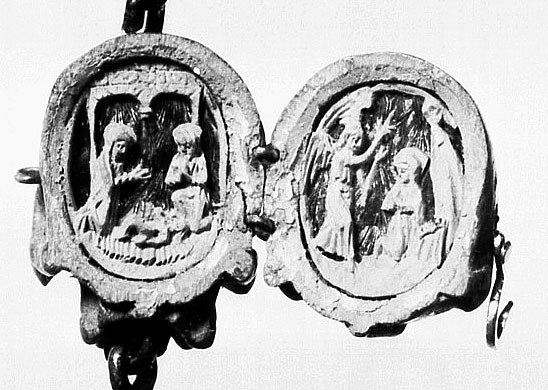
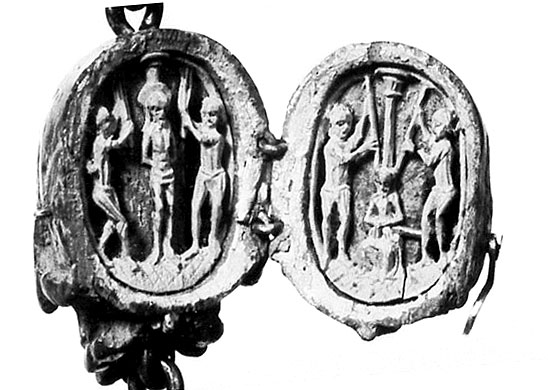
There are seven skulls surviving, making 14 scenes, and it seems likely that this is not a complete set. A short paternoster string like this one is generally ten beads, so we may be missing three. The scenes do tell a story, with one scene mounted in the front half of the skull (left in these photos) and another in the back half.

These are not quite as well carved as the kind of excruciating detail that we see in the European "prayer nuts" carved with intricate scenes in boxwood around this time. Rather they seem to belong to a group of carved miniatures that were largely created in Mexico, under the Spanish occupation. The clue is that many of these scenes still show their original backing of iridescent feathers, a technique borrowed from native featherwork and turned to a new purpose by native converts to Christianity. Other such wood scenes with feather backing are known from devotional jewelry and mounted on silver pieces such as chalices or reliquaries.

In this article are photos of the four lower beads of the current seven. I'll post the others in a future message and talk a bit more about what's depicted.

For reference, the skulls are about an inch tall, so the area for carving is a bit less than that.

Skull04

Bead #4 (above): Inside the front half of the skull (left) is a Nativity scene, and in the back half, the Annunciation of the angel to Mary.

Skull05

Bead #5: Front, the scourging of Christ at the pillar; back, the crowning with thorns.

Skull06

Bead #6: Front, Jesus in the garden on the Mount of Olives; back, the Pieta (image of Mary holding the dead Christ on her lap).

Skull07

Bead #7: Front, the betraying kiss of Judas; back, Christ washing the disciples' feet.

Links to the full photo in the Marburg Foto Archive:
Bead #4 full photo
Bead #5 full photo
Bead #6 full photo
Bead #7 full photo

Posts in this series:


Death's head devotions
Skully bits
Skulls: the inside story
Skulls: the inside story, part 2
Skulls: the inside story, part 3
Voldemort
Voldemort, part 2
A skull of one's own
Goth
More living color

Labels:

Monday, June 20, 2005

Skully bits

I gave one of my friends a rosary a few years ago that I'd made of olivewood beads, with small bone skulls as the markers. "Ooooh!," she exclaimed when I gave it to her, "one with skully bits!"


As I mentioned in Death's-Head Devotions a while back, the actual evidence for skulls connected with rosaries is not very strong. However there's a spectacular exception: a string of seven skulls (almost certainly ten originally), which dates from the 16th century. It's now in Germany, but almost certainly comes originally from Mexico. The carved boxwood skulls open into two halves, and inside each half is carved a miniature religious scene, with a background of iridescent feathers -- a type of work almost unique to the Spanish colonies in America.

Skull Paternoster

We can be fairly sure there were originally more than seven of these skulls because some of the "pairs" of scenes in the two halves of one skull (as currently assembled) don't match. When there is a pair of religious scenes in a "fold-out" bead like this, they generally have something to do with each other, such as one from the Old Testament and one from the New that are seen as having some symbolic connection (such as Jonah and the whale, seen as pre-figuring Christ's resurrection) or they are parts of the same story (such as two scenes that follow one another in Christ's life story).


This is one of the pieces that I most wanted to make a replica of -- without the expensive boxwood carvings, anyway. And I was lucky enough to walk into the local bead store at a time when they had skulls carved from individual peach pits, which I'd never seen before and never have since. They're about an inch tall, and I was able to get them vertically drilled so I could assemble them one above the other like the original.

This took me longer than some of my other projects, first because I had to find just the "right" ring, in-between beads and terminal pendant (all are sterling silver), and also because I'm not very confident of my ability to make passable-looking wire links. But this was one of several projects I was determined to finish and send off to Kalamazoo with my other rosaries, so I got up the nerve to finish it. Here's my version:

Skulls

I'm not completely satisfied with the way this came out. I used base-metal wire, since it was my first try. It was easy to manipulate, but I need more practice making the links, to make them all smooth, tight and even. I also noticed when I looked again at the original that its links are merely bent into loops, not wrapped to anchor them. Wrapping is more secure, but requires additional space and makes it harder to snug the loops up tight to the beads.

Skulls detail

I do have some silver wire that I bought to do a "final" version of these beads, and at some point, I'll probably take it apart and re-do it.

Posts in this series:


Death's head devotions
Skully bits
Skulls: the inside story
Skulls: the inside story, part 2
Skulls: the inside story, part 3
Voldemort
Voldemort, part 2
A skull of one's own
Goth
More living color

Labels: