Thursday, November 20, 2008

Of flexwire and time machines

string theory, part 5


As I discussed previously, "flexwire" or nylon-coated wire has become the most popular modern material for stringing rosaries, and it requires some new techniques.

Modern rosary makers, being used to a type of rosary where the beads don't slide, have had to figure out how to string a rosary on flexwire so that the beads maintain their spacing and don't move. The solution most of them use is to string one to several very small beads between each main bead of the rosary. This also nicely covers the wire, which many people don't find very attractive -- particularly the early versions of coated wire, which resembled stainless steel wire from the hardware store. Many people have become very creative with these "betweens" (in German these would be "zwischenperlen," which I think is a delightful word!). Rosary makers like Mary's Prayers Rosaries may use two or three different types of small beads between each large one, which can make quite an attractive contrast.

With the newer types of coated flexwire, which come in at least a dozen different colors, it would seem logical to me to experiment with making modern rosaries with beads that can slide as you count them. This would mean leaving some of the wire exposed, but if it's pretty, why not? So far I haven't seen anyone try this, but it would be interesting to see how well it works and what people think of it -- and how the flexwire stands up to abrasion when beads are sliding back and forth.

As we've seen, flexwire is pretty much immune to a lot of the problems of rosaries made with string: it's very resistant to tangling and kinking, to breaking by being pulled on and to metal fatigue. But it's not perfect. To the surprise of some rosary makers, rosaries strung on flexwire can stretch with use.

You'd expect this with fiber-based threads -- in fact I've had to re-string some of my paternosters where the silk thread has stretched. But it's rather a surprise to see the same thing happening to wire. Jennifer of Miracoli Rosaries reported that one of her customers' rosaries stretched nearly an inch after just three months of regular use. On checking her stock, she found that several rosaries made with stone beads that had been simply stored hanging up for a year had also stretched.

This caused a bit of consternation on the Rosary_makers mailing list. What could have caused it? The answer seems to be that the metal wire in flexwire is not a single strand, but several strands, braided. If it's subjected to a lot of tension, it turns out that this braided strand can stretch a certain amount, even though the individual wires in it don't. This is especially likely to happen if a light weight of flexwire is used to string heavy beads, so the advice is to use the heaviest weight that will go through the bead holes. (Most flexwire comes in at least two or three thicknesses.)

The other thing that can cause stretching is if the strand of flexwire is used right off the spool, and is then pulled very tight to fasten it off after stringing the beads. This can be prevented if you "relax" the wire before using, or stretch it a few times between your hands, and perhaps let it hang overnight with the beads on it before finishing off.

To sum up, flexwire has a lot of advantages, and has made it much easier for creative rosary makers to produce strong, durable rosaries very quickly. But I have to point out that there's one type of project for which it still doesn't work very well. That is for close replicas of historical types of prayer beads from before 1600. If you want to make your beads look like they just fell through a time machine from the 15th century into your living room, even the newer, more flexible varieties of coated wire still don't work quite like silk thread. Here's an example from Rosary Workshop:
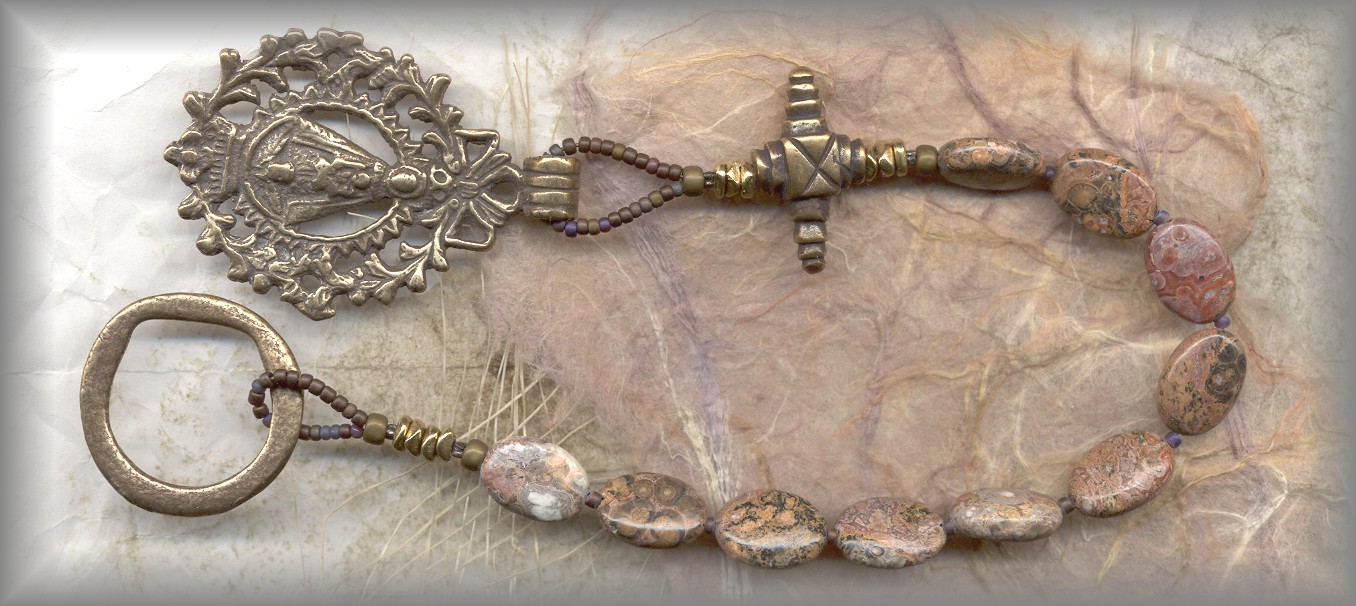


A rosary strung on flexwire simply does not hang the same way as one strung on silk, and it doesn't look the same lying on a flat surface either. The flexwire resists bending, so the strand of beads tends to lie in a gentle, nearly straight curve, and the loops where the end of a strand of beads attaches to a pendant or medal, fall in wider and more gradual curves. There are quite a few historical paintings that show a rosary casually tossed on a side table or step and about to slide off the edge, and you can definitely see the difference in the way they hang.

Messina-1473-detail

(The above example is a detail from Antonello da Messina's St. Gregory Triptych, 1473.)

Fortunately, most people are not trying to pretend that their rosary dropped through a time machine from some other century, so the different drape doesn't matter in the least. I cheerfully admit to being a modern person myself, and I'm thankful for many things about modern civilization, including the Internet! Historical rosaries are not the only beads I string ;)

Posts in this series:


String or Nothing
The thread thread
String Theory
Threads of silk and gold
Wired
Flexwire
Of flexwire and time machines

Labels: ,

Tuesday, November 11, 2008

Flexwire

string theory, part 4


Silk thread and wire links, the rosary-stringing methods of choice for most of history, are no longer the only choices. Within the last decade or two, there's been a revolution in the bead-stringing world. Various forms of plastic-coated wire are now the "string" of choice for many uses.

The first coated-wire product to hit the market (or at least the first one I became aware of) was "Tiger Tail," which is a miniature braided stainless-steel cable covered with nylon. Originally it came only in the natural silvery color of the wire, but you can now buy gold-colored versions too. In more recent years, Acculon and other companies have produced a number of variations, including different thicknesses and even more colors.

Unlike common crafting wire, which is generally made of soft copper or brass, these are mostly based on stainless steel wire, which is much stiffer and very springy. This is especially true of the early versions, which are braids of 3 or 7 strands of wire. More recently, manufacturers have produced 21- and 49-strand versions as well (three braids of 7 and 7 braids of 7, respectively). When more strands are used to produce the same size braid, the individual strands have to be thinner, and thinner strands of wire tend to be more flexible and less springy. This means that the 21- and 49-strand versions are considerably more flexible and "drapey" than the 3- and 7-strand types.

Flexwire (as I'll call this type of product in general) has some advantages over both wire-linked construction and fiber-based string, particularly if your main concern is sturdiness. Because the core of flexwire is metal, it can support very heavy beads, such as the denser types of stone beads. It's also very resistant to tensile stress -- it won't break easily when you tug on it, or if it catches on something. Tension breaks seem to be the main problem with most modern strings of beads, so this is a big advantage for makers of modern necklaces, bracelets and rosaries. The springiness of flexwire also means it's not very subject to breaking from metal fatigue, which occurs if a small area of wire is bent sharply back and forth several times and becomes brittle.

eclecticrosary
(This rather interesting modern rosary strung on flexwire is something I saw a couple of years ago on eBay. I have it labeled as "eclectic"!)

However, using flexwire also requires some differences in technique. Since it's hard to bend flexwire sharply, it's difficult to tie knots with it; the knots tend to resist tightening because of the wire's stiffness, and later to slip out because of the smooth nylon coating. This means that in order to secure the ends of the wire, instead of a knot you have to add a "crimp bead." These are small tubes of metal of just the right degree of hardness. The end of the wire is passed through the loop of a clasp, medal, or other ending and doubled back on itself. The crimp bead is slipped over both of the parallel wires and then squeezed with pliers to grip both wires tightly. This supplies the friction necessary to keep the wires from springing apart and the beads slipping off. (If a crimp bead is squeezed too firmly, it can cut through the nylon coating, weakening the wire.)

I'm much indebted here to Rosary Workshop and to the members of the Rosary_Makers mailing list, many of whom use flexwire to make modern rosaries. Several of them graciously answered my many questions about flexwire and any potential problems with it, and gave me permission to quote them.

Laura Eckert of Still Stone and Moss, for instance, did some testing of her own, and reports: "I held both ends of a piece with pliers and yanked as hard as I could. (I'm pretty strong.) After many mighty yanks, the wire finally broke -- right at the edge of the pliers. Could have been the sharp edge of the pliers that cut the wire. (For necklaces, I use a clasp that WILL break, so nobody gets strangled.)

"I tested crimp connections the same way. No crimps ever lost their grip. Even the crummiest crimps held -- this could be due to SoftFlex's nylon coating. Crimps closed with gentle pressure held as well as crimps closed with a death-grip. (I use crimping pliers -- the kind that first dent & then wrap the crimp.)

"I bent a piece of SoftFlex firmly at a U-turn angle with pliers, and the wire did "remember" that bend. Under ordinary conditions, it doesn't kink. For two-plus years, I've kept a rosary strung on 49-strand SoftFlex jumbled in the bottom of my purse -- when I pull it out, it falls into position without any weird bends. Rosaries left draped over the top of a 1/4" board for several months developed a slight bend, but returned to normal when suspended for an hour or so.

"No problems with abrasion to report after 4-plus years of use with a variety of beads, including stone & metal. No signs of wear even at the crimp points on a bracelet worn daily for several years."


Posts in this series:


String or Nothing
The thread thread
String Theory
Threads of silk and gold
Wired
Flexwire
Of flexwire and time machines

Labels: ,

Wednesday, August 20, 2008

Wired

string theory, part 3


I've been writing about string, since during the period of history I'm most interested in, the vast majority of all rosaries were made from beads threaded on some sort of string -- often silk, sometimes linen or other materials. But starting in the late 16th century (I think), we begin to see the occasional set of beads with the wire-linked construction we're used to seeing in modern rosaries.

OrchidCubes

Dating this innovation is challenging, since -- as I keep saying about other paternoster history questions -- we just don't have a lot of surviving rosaries from that time period to provide us with data. And unlike some of the other questions I've researched, period paintings and illustrations are no help here, since they don't usually show this level of detail -- we're lucky, in fact, if they even show anything of the string, as they do in a few cases such as the Hoccleve portrait of Geoffrey Chaucer, where you can just about see that the thread is red. Nor do inventories and documentary evidence usually shed much light on how a rosary is constructed: usually the only details are what material the beads are made of, and sometimes their number.

As I've mentioned earlier in this series of posts, wire-linked construction has some advantages over string: the chain of beads is less breakable and doesn't need re-stringing as often. On the other hand, a wire chain is less flexible than beads strung on thread, and it's still prone to kinks and tangles. Since the beads are fixed in place and not movable, the different construction also changes the way the beads are handled while praying. Rather than beads sliding along a thread one by one, the entire chain of beads moves through the hands, one bead after the next being held between the fingers.

As a method of construction, wire linking is very simple, but somewhat labor-intensive, since until recently each loop on a wire-linked rosary had to be made by hand. Instructions for this are fairly easy to find, but most people find that it takes a bit of practice to be able to make even, consistent links that look nice and hold their shape well.

The first essential is the choice of wire. It needs to be strong, even in thickness, and thin enough to pass through a bead easily. It also has to be the right hardness. The same metal can behave quite differently depending on whether it is "hard" or "soft," and wire for making chains has to have just the right balance between the two. When metal is heated and cooled, it becomes "soft," which means it is more malleable, but easily pulled out of shape. As it is bent, twisted, hammered or worked in other ways, it becomes "harder," which means it will hold its shape better, but it also becomes more brittle and prone to break. For making chains of beads, the wire must be bendable so you can make loops, stiff enough that the loops will hold their shape under stress, but not so hard that it will break.

Aloe-wood-detail

We take abundant supplies of fine metal wire for granted today, but for a long time all wire was hand made and somewhat expensive. Comparing a beautiful woman's hair to fine metal wires was a compliment to its shine and liveliness! Wire-drawing only became a major industry in Western Europe in the late 1500s. It's probably no coincidence that a number of crafts requiring consistent supplies of even, strong wire blossomed around that same time -- not only wire-linked bead work, but for instance also silk knitting, which requires fine wire needles.

Anyway, to make a long story short -- I haven't yet seen any examples of wire-linked paternoster beads that I am convinced are original and date to much before 1600. I've been shown a few groups of rosaries that have some wire linking and a photo caption saying "XV Jh." (German "Jahrhundert" meaning "century") but none of them convince me. In one case, the style of the metal parts looks very much like 18th-century filigree. Another seems to be something constructed from part of a broken rosary, and I don't see any clear indications of date on that one either.

The wire-linked beads that do look more convincing are a few tenners. Considering Bishop Fugger's beads are wire linked and date from somewhere between about 1604 and 1626, this isn't too surprising. The added labor of forming wire loops might make a bit more sense when there are just a few beads to link.

The earliest long rosary that I know of with wire links is this Portuguese rosary of aloe wood, with a somewhat vague date of "early 17th century" according to the book I got it from. You'll note, by the way, that this is a six-decade rosary, with 63 beads, sometimes called a "Birgittine" rosary.

Aloe-wood

Rosaries and paternosters are notoriously difficult to date precisely, and like any other jewelry, they were also subject to re-making and repairing as they became damaged or tastes changed. I'm certainly open to the possibility of earlier wire-linked beads, but so far both the evidence I've seen, and what I know of the social and technological background, lead me to think that late 16th to early 17th century is still the most likely date for this innovation.

Posts in this series:


String or Nothing
The thread thread
String Theory
Threads of silk and gold
Wired
Flexwire
Of flexwire and time machines

Labels:

Wednesday, August 13, 2008

Threads of silk and gold

String theory, part 2


In my previous post, I focused mostly on plain silk, which seems to have been the thread of choice for medieval rosaries, and discussed some of the reasons it breaks. Here I'm going to discuss other types of silk thread, including silk with gold.

Since the biggest problem with silk thread is weakening by abrasion from the beads sliding along it, you'd think that people would choose threads that wouldn't be harmed by abrasion. Not so, apparently. I have seen a number of references to beads threaded on, for instance, "crimson silk and gold." And -- if I had any doubt that the gold was actually part of the stringing and not just decorative -- King Rene d'Anjou had a rosary "strung on a cord of silk and gold thread."

Before the days of plastic coatings it wasn't easy to make gold thread, or even imitation gold thread. Gold is a soft metal, and while it's possible to make a very thin gold wire that can be woven like thread, it is rather fragile and breaks when repeatedly bent back and forth. In embroidery it was mostly laid on the surface of the cloth and held down with stitches, rather than being threaded into a needle and passed in and out of the fabric.

Gold wire is also very heavy and expensive, so ways to make a thread that was lighter and more affordable were invented early. In the Middle Ages and Renaissance, most gold thread was made by beating gold very thin, cutting it into strips, and wrapping the strip in a spiral around a "core" thread, usually yellow silk. The silk core made the thread much more flexible and less breakable.

On the other hand, the actual gold coating on the thread was quite thin. This meant that while the thread would bend readily and you could, with care, actually pass the thread through fabric, its tolerance for abrasion was still very limited. In embroidery this thread was still mostly laid on the surface of the cloth and stitched down (called "couching"). I have difficulty imagining why anyone would thread beads on something this easy to damage -- yet clearly it was done.

A fragile thread might be made somewhat sturdier if it is not simply twisted, but actually braided or woven. I started out using ordinary silk twist to string paternoster beads with, and I think that is one reason I've experienced so much thread breakage -- especially because I haven't plied my own from reeled silk, but used commercial twist from machine-spun silk. (The Japanese Embroidery Center has been recommended to me as a source of reeled or "flat" untwisted silk.)

As with any fiber, the first step is to make a single thread out of collected fibers. Silk twist is the next step in processing, where two threads -- each composed of many fibers -- are twisted around each other. I suspect that this results in relatively long stretches of fibers being exposed to wear between the places where the threads twist around each other. The twist also does not exert a great deal of pressure on the individual fibers or prevent them from moving. My guess is that this means that when a few fibers are abraded and break, the breakage has a good deal of freedom to spread to other nearby fibers as they take up the load released by the broken fibers.

Bedes-9

A compound thread that is braided or woven, on the other hand, has much shorter exposures of fiber, and the intersections where groups of fibers go over or under each other are generally tighter and exert some pressure to keep the fibers from moving. So we might expect slighly better survival of threaded paternoster beads strung on braided or woven thread. I'd be very cautious about generalizing from the very few examples that exist, but indeed I'm aware of at least two surviving strings where fragments remain of a braided or woven cord. (Of course there are also surviving bits of twisted cord, so I wouldn't call the question settled.)

One is this set of 15th- or 16th-century jasper beads from Salzburg, which -- if I remember correctly -- were found on a length of pink silk cord that had been tablet-woven.

Salzburg-jasper

Tablet weaving, or card weaving, is a technique usually used to make narrow flat strips by a technique that combines twisting and weaving threads together. It's an ancient technique and quite common in the European Middle Ages and Renaissance. A slight modification of the technique produces a round woven cord with a hollow center.

Simple braiding is of course another very common techique for producing cord. I was particularly charmed to discover "whipcord braiding," which uses two people and four hanging bobbins to produce a round four-strand plait very quickly and easily. (There's a YouTube video here.) I think we tend to under-estimate how many period techniques were done with two or more people cooperating, since as modern people we are more likely to produce our crafts alone.

A third technique, which was common in the Middle Ages and Renaissance but largely forgotten in modern times (until its recent revival), is called "fingerloop braiding," and uses (as you'd probably guess) loops of thread carried on the fingers rather than straight cords with loose ends. It can be very fast, and produces fascinating, intricate patterns. It's pretty much limited to making short lengths of cord -- a yard or two at most -- but for the length you need for a paternoster, that's no problem.

Dubhgall

Just last weekend a friend for whom I've made a paternoster commented that hers needed re-doing and she was planning to make a fingerloop braid for them. I've also made a copy of my "Magdalen" beads for another friend (seen above), also with a fingerlooped cord. I'll be interested to see whether these wear better and last longer, but I suspect they will.

Posts in this series:


String or Nothing
The thread thread
String Theory
Threads of silk and gold
Wired
Flexwire
Of flexwire and time machines

Labels:

Wednesday, August 06, 2008

String theory

It's been awhile since we discussed threads. Up until about 1600, most paternosters and rosaries were strung on a thread of some sort. Having had some interesting discussions on thread with the folks in the Paternosters Yahoo group, I thought it might be a good time to revisit the subject.

The original threads of old paternosters and rosaries seldom survive. Having now owned and worn a number of medieval rosaries, I have a better appreciation of why that might be. Even silk thread -- which was probably the strongest available fine thread in the Middle Ages -- is neither unbreakable nor immortal. I don't wear my medieval-style reproductions all that often, and some of them are on their second or third stringing within ten years. Friends to whom I've given such beads have brought them back for re-stringing after as little as eighteen months, and discussions on some of the mailing lists I subscribe to include comments from people who wear necklaces of Anglo-Saxon or Viking-style beads, who also report that these need to be re-strung every couple of years (which provides an opportunity to re-arrange them, so it's not all bad).

(By the way, the photos in this post are just here as decoration. They are paternosters I've made at various times, mostly as gifts.)

Maureen

Threaded rosaries are inherently more prone to breakage than the wire-chain construction so common in modern rosaries. My guess is that wire-chain construction began to gain in popularity at the end of the 16th century for precisely this reason. Wire chain has some disadvantages -- it does tangle and kink, sometimes quite badly, as the wire loops at the end of each link catch on each other. Putting each bead on a separate wire link also means you cannot slide the beads along the thread as you count them; instead, the entire rosary is passed through the hands, one bead at a time, which gives a different "feel" to the counting process.

Thread breakage in period must have been very common. I no longer wonder why so many of the threaded paternosters and rosaries mentioned in 15th- and 16th-century wills and inventories have strange numbers of beads, such as 114, 32 or 83 ;)

Why and how threads break depends on what kind of stresses the thread is subjected to. Tensile strength is one factor -- how hard it is to break a thread by pulling on the ends. Another factor is resistance to abrasion -- how much the thread is weakened by the friction of beads sliding back and forth. A third factor is "fatigue" -- how much something is weakened by being repeatedly bent in different directions. Silk thread is pretty good on the first, not good on the second, and the third is (as far as I know) no problem at all. Metal wire is very good on the first two, not so good on the third.

One thing to consider is that medieval silk thread may well have had more tensile strength than modern silk thread, so perhaps modern experience is not quite comparable. Most silk thread today is machine-spun, which requires that the very long silk fibers be chopped into short pieces. "Reeled" silk, which preserves the original fiber length, is likely to be stronger, and in fact a lot of modern synthetic fibers like nylon make strong thread at least partly for the same reason. Much of the silk thread available in the Middle Ages and Renaissance (if you could afford silk at all) was reeled, so this may have made a difference. It would be interesting to test the two types and see how different they are.

Another thing to consider is how much care is taken by the wearer of the beads to keep them out of situations where they might break. Modern rosaries are often rather carelessly knocked around, carried loose in the bottom of a pocket or purse, or perhaps hung from a car's rear-view mirror (however much this is frowned on by safety experts!). In the Middle Ages, rosaries seem to have been more often worn out in the open like jewelry, often pinned to clothing, wound around an arm or hanging from a belt. This puts them in situations where they are very likely to catch on something, and I've had several sets of beads do exactly that while I was wearing them -- a dangling loop catching on a doorknob, for instance, or the most recent instance where the cross at the end of my Saint Hedwig beads got caught in the crack of a wooden bench, and the string snapped when I stood up quickly.

Bedes-3a

I would guess, however, that silk thread's major weakness is from abrasion due to friction. It seems to have been the custom to slide each bead along the thread as it is counted while praying. The beads can also slide back and forth as they are picked up or put down, worn or carried. As far as I can tell, medieval rosaries did not have knots between each bead (as, for instance, pearl necklaces often do). That would have interfered with sliding them, and incidentally it also means that if the thread does break you are likely to lose several beads rather than just one or two. (So far I've mostly been lucky enough to find all the beads when mine have broken, though there are still three little red glass beads in my car somewhere.)

Friction between beads and thread also depends on craftsmanship. Virtually all modern beads are machine-made, and the holes are likewise drilled by machine. This guarantees a smooth hole inside, but it can leave fairly sharp edges where the hole enters or leaves the bead. I would guess that when beads were made by hand, the openings of the holes could have been smoothed with a file, and if so, abrasion would have been lessened.

Other threads available at the time probably shared some of these weaknesses. The most plausible thread for rosaries for those who could not afford silk is probably linen or hemp. Both of these are fairly strong in terms of tensile strength -- especially if the linen is "line" spun using the full length of the fibers -- but they are also not as smooth as silk, which would have increased the friction between thread and beads. Wool thread is not very likely as a stringing material because it also has a rough surface, and compared to the others, it is relatively short-fibered and has much less tensile strength. A single reeled silk fiber may be dozens of feet long in the uncut state. Linen and hemp fibers are often as long as the plant is tall, as much as three or four feet. The longest wool fibers I know of are six to eight inches, and they are far more commonly found in the one- to three-inch range.

Posts in this series:


String or Nothing
The thread thread
String Theory
Threads of silk and gold
Wired
Flexwire
Of flexwire and time machines

Labels:

Sunday, December 05, 2004

The thread thread

Just to follow up recent discussions on what beads are threaded on --

I recently re-read two chapters of the invaluable and weighty tome Medieval European Jewellery by Ronald Lightbown, namely "Jewellery for Men & Women, Gifts & Religious Offerings" and "Paternoster Beads."

I was actually looking for something else, but I came up with a couple of specific descriptions of what beads were threaded on, which I thought I'd mention. Somewhat unfortunately for us, these are about beads belonging to relatively wealthy people, so it doesn't tell us much about ordinary folks. Still, it's something.

1432, Rene of Anjou. "Beads of musk, strung on a cord of silk and gold thread."

1498, Lady Anne Scrope. Left to Our Lady of Walsingham, "ten beads of her great gold paternoster, which was threaded with crimson silk and gold, and had a great button of gold, and a tassel of the same cord." (The "button" referring presumably to an especially fancy bead at the end.)

1503, Robert Preston, a glazier of York. Left "a set of ten chalcedony beads threaded on a lace of green silk with a gilt pendant of St. Martin."

Posts in this series:


String or Nothing
The thread thread
String Theory
Threads of silk and gold
Wired
Flexwire
Of flexwire and time machines

Labels:

Wednesday, October 20, 2004

String, or nothing

The first question that always comes up when someone wants to make a medieval paternoster is what kind of beads to use. The second question is almost always, "And what kind of thread do I string them on?"

The answer I usually have to give is that we don't have a lot of evidence to go on. In paintings, usually you can't see that kind of detail, because the painter didn't often paint at such a small scale. To complicate matters, we often have no idea just how realistic the painter was trying to be, as evidenced by the number of painted rosaries whose beads seem to be disproportionately big, or of a number like 28, 16, or 39 that doesn't seem to match any set of plausible prayers.

We also don't have much evidence from surviving rosaries or paternosters. As far as I know, all the surviving pre-1600 beads that have survived have been re-strung — except those very few discovered in the last ten or twenty years, which have been recovered from archaeological contexts and were preserved with their cords. (For a long time, remnants of fibers, strings and cloth were simply tossed on the trash heap by archaeologists — fortunately this rarely happens any more.)

This means that just as we can't completely trust what we see in paintings, we can't completely trust the way in which surviving beads may have been re-strung. We hope that whoever re-strung the beads followed the original pattern carefully, but we usually have no evidence whether they did or not.

All this makes it sound like there's no trustworthy evidence at all: well, we do the best we can through comparing different types of evidence, just as we do for other difficult (I was going to say "knotty"!) questions.

For what it's worth, though, we do have a couple of data points. There's at least one 16th-century set of beads in Köln (Cologne, Germany) that are strung on a bright pink silk cord. There is also a 14th-century English example in the Museum of London: eight amber beads still threaded on a tubular tablet-woven string of silk. (From: Crowfoot, Elisabeth, Frances Pritchard and Kay Staniland. Textiles and Clothing, c.1150-c.1450: Medieval Finds from Excavations in London: 4. London: Boydell Press, 2001.)

My own conclusion is that threading beads on silk twist is the best guess in most cases, given what evidence we have. I would hypothesize that in less wealthy contexts, linen or hemp cord would be plausible. Wool is unlikely because it tends to be considerably less strong by comparison, and doesn't take abrasion well as the beads slide back and forth.

As for knots: a good many of the images of medieval rosaries I've seen are clearly strung on a plain thread, with no knots between beads, so that the beads can be slid along the thread one by one as the prayers are said: for example, in a portrait of the Madonna and Child by Ambrogio Fossano. I have heard rumors of period pearl necklaces with knots between the beads, but have never seen anything resembling evidence for this (it tends to be argued on grounds of "common sense," but we all know that what seems sensible to us didn't necessariy seem so to people in history).

By the way, yes it is more than a little odd to see the Infant Jesus playing — most anachronistically — with a rosary; but there are a lot of medieval paintings showing exactly that!


Posts in this series:


String or Nothing
The thread thread
String Theory
Threads of silk and gold
Wired
Flexwire
Of flexwire and time machines

Labels: